What Scopes/Optics Do Special Forces Use? A Guide to Military Rifle Optics
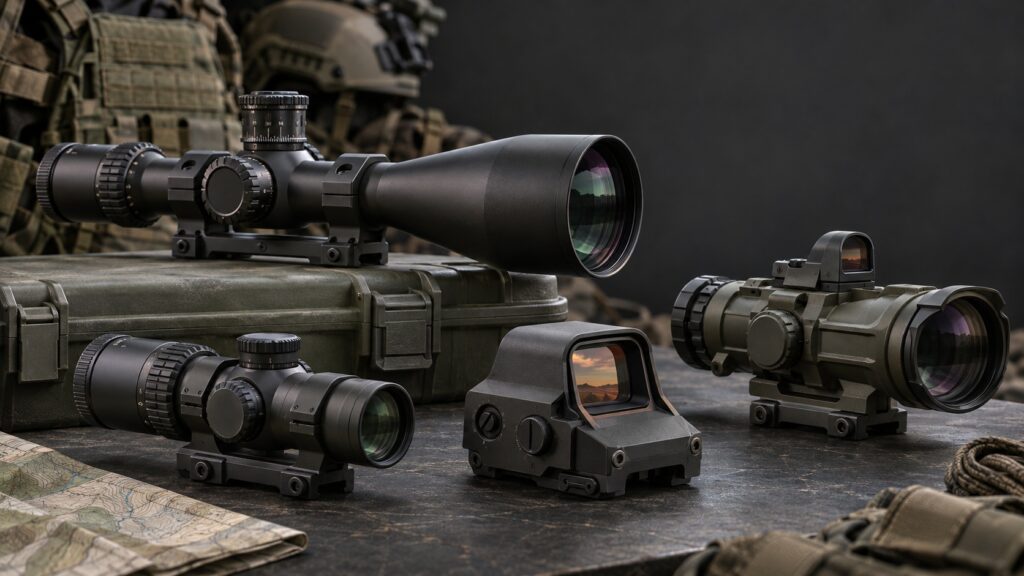
What scopes do special forces use? From Navy SEALs and Army Green Berets to the 75th Ranger Regiment and other elite military units, special operations forces rely on some of the most sophisticated rifle optics available.
Nightforce, EOTECH, SIG Sauer, Trijicon, Elcan, Schmidt & Bender, Leupold, and Aimpoint are among the best-known names associated with military weapon sights. However, not every optic associated with the military has been officially selected by U.S. Special Operations Command (USSOCOM).
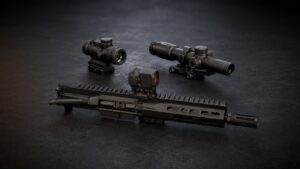
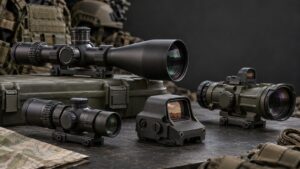
The specific optics used by special forces depend on the weapon, operational requirements, procurement contracts, and individual unit. Some are compact, unmagnified red-dot or holographic sights. Others are variable-power riflescopes designed for precision shooting at extended distances.
Importantly, many of these optics—or closely related commercial versions—are available to civilian consumers through retailers such as OpticsPlanet.
This guide examines the actual scopes and optics used by special operations forces, including documented military contracts, the technology behind these sights, and the differences between military-issued and commercially available models.
What Optics Do Special Forces Use? A Quick Comparison
The following are some of the most significant optics with documented U.S. special operations connections or other established military service histories.
| Optic | Magnification | Documented military connection |
|---|---|---|
| Nightforce ATACR 1-8×24 F1 | 1-8x | USSOCOM Squad-Variable Power Scope |
| SIG Sauer TANGO6T | 1-6x | USSOCOM S-VPS selection |
| Nightforce ATACR 4-20×50 F1 | 4-20x | USSOCOM Ranging-Variable Power Scope |
| Nightforce ATACR 5-25×56 F1 | 5-25x | USSOCOM Precision-Variable Power Scope |
| Nightforce ATACR 7-35×56 F1 | 7-35x | USSOCOM long-range P-VPS |
| EOTECH Holographic Weapon Sights | 1x | USSOCOM close-quarters optics contracts |
| Elcan SpecterDR | 1x/4x | USSOCOM SOPMOD program |
| Trijicon ACOG | Commonly 4x | U.S. military and special operations service |
| Schmidt & Bender PM II | 5-25x, 3-27x | Historical USSOCOM precision rifle selections |
| Leupold Mark 5HD | 5-25x | U.S. Army Precision Sniper Rifle program |
| Aimpoint CompM4/M4S | 1x | U.S. Army M68 Close Combat Optic |
These represent publicly documented selections and service histories, not a verified inventory of every optic currently carried by every special operations unit.
Nightforce: The Scopes Officially Selected by USSOCOM
If there is one manufacturer that deserves particular attention when discussing the scopes special forces are using, it is Nightforce Optics.
The company’s ATACR (Advanced Tactical Riflescope) family has received multiple USSOCOM selections for military precision and variable-power optics.
Nightforce has publicly identified four military-classified ATACR configurations:
- SU-294/PVS — ATACR 1-8×24 F1
- SU-303/PVS — ATACR 4-20×50 F1
- SU-295/PVS — ATACR 5-25×56 F1
- SU-296/PVS — ATACR 7-35×56 F1
These models occupy different roles, ranging from low-power variable optics to high-magnification precision riflescopes.
Nightforce ATACR 1-8×24 F1: The Special Forces LPVO
The Nightforce ATACR 1-8×24 F1 is a low-power variable optic, commonly called an LPVO.
It offers magnification from 1x to 8x, combining some of the capabilities associated with unmagnified sights and conventional magnified rifle scopes.
Its distinguishing characteristics include:
- First-focal-plane reticle
- Illuminated aiming reticle
- Compact construction
- Extra-low dispersion (ED) glass
- Rugged, weather-resistant housing
- Variable magnification from 1x to 8x
Nightforce has identified its MIL-SPEC 1-8×24 as the SU-294/PVS, a USSOCOM Squad-Variable Power Scope.
That distinction is important: the military contract configuration includes specifications, accessories, and testing requirements that may differ from commercial versions.
For civilians interested in the same general optical platform, the commercial ATACR 1-8×24 F1 is a closely related alternative.
Commercial model: Nightforce ATACR 1-8×24 F1 at OpticsPlanet
Nightforce ATACR 4-20×50 F1: The Designated Marksman Scope
In June 2021, Nightforce announced that USSOCOM had selected the MIL-SPEC ATACR 4-20×50 F1 for its Ranging-Variable Power Scope (R-VPS) program.
This system was intended for mid-range and designated marksman applications, including semi-automatic sniper weapon systems.
Compared with the 1-8×24 LPVO, the ATACR 4-20×50 offers substantially greater magnification, making it more suited to precision observation and long-distance work.
Its specifications include a 50mm objective lens, first-focal-plane reticle, adjustable parallax, and illuminated reticle options.
Nightforce described the military program’s intended capability as extending to engagements at approximately 1,200 meters. That is a program objective rather than a guarantee of performance under every condition.
Commercial model: Nightforce ATACR 4-20×50 F1 at OpticsPlanet
Nightforce ATACR 5-25×56 F1: A Special Forces Sniper Scope
The ATACR 5-25×56 F1 is one of the clearest examples of a modern precision riflescope officially selected for special operations.
In December 2019, Nightforce announced that USSOCOM had selected the 5-25×56 F1 and 7-35×56 F1 as its standard and long-range Precision-Variable Power Scope (P-VPS) solutions.
The ATACR 5-25×56 F1 features:
- 5-25x magnification
- 56mm objective lens
- First-focal-plane reticle
- Available MIL-based and MOA-based reticle configurations
- High-quality ED glass
- Precision adjustment turrets
- Reticle illumination
The larger objective lens, optical resolution, and magnification range help explain why optics in this class are associated with military sniper rifles rather than ordinary infantry carbines.
Commercial configurations are available with several reticle styles, including some featuring the Horus TREMOR3.
However, buyers should not assume that every commercial reticle option is identical to a specific USSOCOM contract configuration.
Commercial model: Nightforce ATACR 5-25×56 F1 at OpticsPlanet
Nightforce ATACR 7-35×56 F1: Extreme Long-Range Optics
The ATACR 7-35×56 F1 provides an even greater magnification range than the 5-25×56.
USSOCOM selected a MIL-SPEC version as its long-range P-VPS solution.
Its principal features include a 7-35x magnification range, 56mm objective lens, first-focal-plane reticle, precision adjustments, and rugged construction.
Nightforce’s original P-VPS announcement described requirements involving target detection and acquisition at approximately 1,500 meters and beyond.
The 7-35x magnification range is particularly noteworthy because it represents the highly specialized end of military precision optics.
Such a scope is not a universal solution for special forces personnel. It is a specialized instrument associated with precision rifle applications.
Commercial model: Nightforce ATACR 7-35×56 F1 at OpticsPlanet
SIG Sauer TANGO6T: Another Official Special Operations Selection
The SIG Sauer TANGO6T 1-6×24 is another significant optic with an established USSOCOM connection.
SIG Sauer states that the TANGO6T was originally selected for the USSOCOM Squad-Variable Powered Scope program in 2017.
The family has also received separate military selections for the U.S. Army Squad Designated Marksman Rifle and the Department of Defense Direct View Optic program.
The TANGO6T combines a 1-6x magnification range with an illuminated reticle and a relatively compact optical design.
Depending on the configuration, the TANGO6T family includes both first- and second-focal-plane models.
The USSOCOM S-VPS configuration has been marketed with a second-focal-plane FL-6 Hellfire reticle, an ALPHA4 mount, and specified military accessories.
Like the Nightforce ATACR, the TANGO6T illustrates the increasing importance of LPVOs in modern military small-arms optics.
Commercial model: SIG Sauer TANGO6T 1-6×24 at OpticsPlanet
EOTECH: Holographic Sights Used by Special Operations Forces
Not every special operations weapon sight is a traditional scope.
EOTECH’s holographic weapon sights are among the most recognizable military optics, particularly in discussions of close-quarters weapons.
Unlike a conventional magnified riflescope, a holographic weapon sight uses a holographic reticle system viewed through a largely unmagnified window.
EOTECH has a substantial history of supplying U.S. special operations forces.
In 2019, its then-parent company L3 Technologies received a USSOCOM contract valued at approximately $26.3 million to provide updated holographic weapon sights and G33 magnifiers.
EOTECH EXPS3
The EOTECH EXPS3 is a particularly relevant commercial example.
Its features include:
- Unmagnified holographic sighting system
- Night-vision-compatible brightness settings
- Compact housing
- Quick-detach mounting system
- Multiple available reticle configurations
- Compatibility with magnifiers
The EXPS3 family is frequently associated with modern military-style rifle configurations.
However, it would be inaccurate to say that every currently issued USSOCOM holographic sight is necessarily an identical commercial EXPS3-0.
Military part numbers and procurement configurations matter.
Commercial model: EOTECH EXPS3 listings at OpticsPlanet
EOTECH G33 Magnifier
The G33 is a compact 3x magnifier designed to accompany compatible holographic weapon sights.
Its documented inclusion in a USSOCOM procurement program makes it more than a generic civilian accessory.
The broader concept is straightforward: a magnifier adds optical enlargement to an otherwise unmagnified sighting system.
Commercial model: EOTECH G33 Magnifier at OpticsPlanet
Elcan SpecterDR: The Famous Dual-Role Special Operations Optic
The Elcan SpecterDR occupies an important place in the history of special operations rifle optics.
The SpecterDR 1x/4x was selected for the USSOCOM SOPMOD Block II program under the designation SU-230/PVS.
Its defining feature is a dual-magnification optical system that switches between 1x and 4x rather than using the continuously variable magnification of a conventional LPVO.
The SpecterDR became associated with special operations carbine configurations, including those used by Navy special warfare personnel.
Its dual-role design was notable during a period when many military optics were either fixed-magnification sights or unmagnified electronic sights.
The SpecterDR remains a significant historical example of how special operations procurement helped popularize versatile combat optics.
Commercial models: Elcan rifle optics at OpticsPlanet
Availability varies considerably by exact SpecterDR version, with some older models discontinued.
Trijicon ACOG: The Classic Military Combat Scope
Few rifle optics have a military reputation comparable to the Trijicon ACOG.
ACOG stands for Advanced Combat Optical Gunsight.
The ACOG family has served extensively with the U.S. military, including special operations forces, and is particularly well known for compact, fixed-magnification designs.
The familiar 4×32 ACOG offers fixed 4x magnification, while other models provide different magnification levels.
One distinctive feature of many ACOGs is battery-free reticle illumination using fiber optics and tritium.
Other configurations, such as the TA02, use battery-powered LED illumination.
The ACOG’s continued recognition is not simply a matter of nostalgia. It represents an established military approach to rugged, compact magnified optics.
Compared with modern LPVOs, its defining trade-off is fixed magnification.
That makes it a useful contrast to the newer Nightforce ATACR and SIG Sauer TANGO6T systems.
Commercial model: Trijicon ACOG 4×32 at OpticsPlanet
Schmidt & Bender PM II: Precision Optics With a Special Forces History
Germany’s Schmidt & Bender is another manufacturer with a documented connection to elite military precision rifle programs.
The company’s PM II (Police Marksman II) family has been selected for military sniper applications around the world.
Schmidt & Bender identifies its 5-25×56 PM II PSR as a winner of a U.S. military Precision Sniper Rifle competition, with deliveries to American special operations forces.
It also identifies its 3-27×56 PM II High Power as a winner of a USSOCOM extreme long-range competition.
These are important examples because they demonstrate that Nightforce is not the only high-end riflescope manufacturer with a legitimate USSOCOM history.
The PM II series is known for premium optical engineering, precision adjustment mechanisms, and specialized reticle configurations.
Some variants remain relevant to contemporary precision shooting, although an older military contract should not automatically be interpreted as evidence of widespread current issue.
Leupold Mark 5HD: The U.S. Army Precision Sniper Rifle Scope
Leupold also deserves consideration when examining military sniper scopes.
In March 2020, the company announced that its Mark 5HD 5-25×56 had been selected as the day optic for the U.S. Army Precision Sniper Rifle program.
The optic was intended for the Mk22 sniper rifle system, based on the Barrett MRAD platform.
This creates an important distinction between the rifle and its optics procurement history.
The Mk22 platform has a USSOCOM connection, while the specific Mark 5HD announcement concerns the U.S. Army’s precision rifle program.
The Mark 5HD offers first-focal-plane reticle options, a 5-25x magnification range, and precision-oriented optical features.
It is a legitimate example of a modern U.S. military sniper scope, but it should not be described as the universal USSOCOM-issued sniper optic.
Commercial model: Leupold Mark 5HD 5-25×56 at OpticsPlanet
Aimpoint: Red Dot Optics With an Established Military Record
Aimpoint’s electronic red-dot sights are another major part of the military optics landscape.
The Aimpoint CompM4 and CompM4S are associated with the U.S. Army’s M68 Close Combat Optic program.
The Army identifies the M68 as a standard-issue sight for the M4A1 carbine.
Aimpoint’s compact Micro T-2 is also a well-known professional-grade red-dot sight, offering a lightweight enclosed design, long battery life, and night-vision-compatible settings.
These are two different procurement claims, however.
The CompM4 has a clearly documented Army standard-issue connection. The Micro T-2 should not be presented as the universally issued special forces red dot without unit-specific evidence.
Commercial model: Aimpoint Micro T-2 at OpticsPlanet
What Is a Special Forces Sniper Scope?
A special forces sniper scope is a precision riflescope selected for a military sniper or precision rifle system, often incorporating features that exceed the requirements of basic sporting optics.
Such scopes may include:
- First-focal-plane reticles with graduated measurement markings
- High optical resolution
- Precise, repeatable adjustment mechanisms
- Large objective lenses
- Weather-resistant construction
- Specialized reticle configurations
- Compatibility with additional observation or night-vision equipment
Examples with documented military connections include the Nightforce ATACR 5-25×56 and 7-35×56, Schmidt & Bender PM II series, and Leupold Mark 5HD.
A first-focal-plane reticle changes apparent size as magnification changes, preserving the relationship between its measurement markings and the observed image.
A second-focal-plane reticle maintains approximately the same apparent size when magnification changes, but its subtension markings generally correspond to specific magnification settings.
Neither design is automatically superior for every application.
Military selection decisions are based on a much broader set of requirements, including durability, configuration compatibility, logistics, testing, and cost.
What Is the Most Expensive and Advanced Type of Optic Used by Special Forces?
There is no single publicly verified answer to the question of which optic is the most expensive or technologically advanced across all special forces units.
The answer depends on whether the comparison concerns conventional riflescopes, thermal imaging, night vision, or integrated optical systems.
Premium Precision Riflescopes
High-end conventional scopes such as the Nightforce ATACR 7-35×56 F1 and Schmidt & Bender PM II High Power series can cost several thousand dollars.
Their expense reflects optical engineering, mechanical precision, demanding manufacturing requirements, and specialized features.
However, magnification and price alone do not establish technological superiority.
Thermal Imaging Systems
Thermal optics detect differences in infrared radiation associated with temperature, producing images that do not depend on the same visible-light conditions as ordinary daytime scopes.
These systems may be significantly more expensive than conventional riflescopes, especially when developed for military use.
Night Vision and Sensor-Fusion Systems
Advanced military night-vision systems can combine image intensification and thermal imaging.
For example, the U.S. Army’s Enhanced Night Vision Goggle family has included systems integrating both technologies.
Such equipment represents a different category of optical capability from a high-magnification sniper scope.
A military organization might therefore consider a sophisticated thermal or multisensor system more technologically advanced than a traditional telescopic sight, even if that traditional scope has exceptional optical performance.
The most advanced optic is not necessarily the one with the highest magnification or the largest price tag.
Why Do Special Forces Use Different Scopes?
A common misconception is that special forces receive one exceptionally advanced riflescope that can perform every task.
In practice, military optics are specialized.
An unmagnified sight is fundamentally different from a high-magnification precision riflescope, and neither necessarily replaces a thermal or night-vision observation system.
Several considerations help explain the variety of equipment:
Weapon platform: A compact carbine and a dedicated sniper rifle have different optical requirements.
Field of view: Magnification changes how much of a scene is visible through an optic.
Weight and dimensions: Optical equipment contributes to the overall size and weight of a weapon system.
Visibility conditions: Ordinary daytime optics, night vision, and thermal imaging rely on different technologies.
Military procurement: Contract awards, component requirements, equipment inventories, and modernization schedules affect which optics are issued.
Reliability: Mechanical durability, weather resistance, and optical consistency are particularly important in professional military equipment.
These factors explain why even elite special operations formations may use several different optical systems rather than a single standardized scope.
Military-Issue Scopes vs. Commercial Optics: Are They the Same?
This is one of the most important distinctions for anyone researching special forces scopes with the intention of purchasing a comparable model.
A commercial product may share a manufacturer, product family, magnification range, and general optical design with a military-issued scope.
That does not necessarily mean the two are identical.
Military contract configurations may include different reticles, coatings, accessory packages, environmental testing, markings, mounting equipment, or production requirements.
Nightforce explicitly notes that its MIL-SPEC riflescopes receive additional testing and that contract-specific products are not ordinarily available to the commercial market.
The same basic consideration applies when comparing commercial SIG Sauer or EOTECH products with military procurement configurations.
If you encounter a retailer advertising an optic as “military grade,” “SOCOM inspired,” or “special forces approved,” those descriptions should not automatically be interpreted as proof that the product is identical to an issued military part number.
For anyone researching a particular optic’s military background, manufacturer announcements and procurement records are more useful evidence than advertising language.
Frequently Asked Questions About Special Forces Optics
What scopes do Navy SEALs use?
Navy SEAL equipment has historically included EOTECH holographic sights, Elcan SpecterDR optics, and specialized precision riflescopes. Nightforce and other manufacturers have received broader USSOCOM contracts that include naval special operations components.
However, public procurement information does not establish a single current scope used by every SEAL team or individual operator.
What optics do Army Special Forces use?
U.S. Army Special Forces, commonly called Green Berets, operate within the broader USSOCOM equipment environment. Relevant documented optic families include Nightforce ATACR systems, SIG Sauer TANGO6T variable-power scopes, EOTECH holographic sights, and other military-issued optical equipment.
Specific configurations vary according to requirements and available equipment.
What scopes do Army Rangers use?
The 75th Ranger Regiment has historically used military carbine optic families associated with USSOCOM, including holographic sights, magnified combat optics, and variable-power scopes.
A particular manufacturer’s contract does not prove that every Ranger currently uses the same model.
What is the most advanced sniper scope used by special forces?
Among publicly documented USSOCOM precision riflescope selections, the Nightforce ATACR 7-35×56 F1 and Schmidt & Bender PM II High Power family are notable examples.
There is no authoritative public ranking establishing one as the most advanced across every special operations unit.
What does a special ops optic do?
A special operations optic provides an optical or electronic sighting capability appropriate to a particular military requirement.
Depending on the design, it may provide magnification, illuminated aiming references, enhanced low-light visibility, thermal imaging, or other observation capabilities.
A holographic weapon sight performs a substantially different function from a conventional high-magnification sniper scope.
Why do special forces have “hat scopes”?
People sometimes use informal descriptions such as “hat scopes” when referring to the optical devices mounted on military helmets.
These are typically helmet-mounted night-vision goggles, monoculars, or other observation systems—not conventional riflescopes.
Their purpose is to support visibility and situational awareness, particularly in darkness or difficult visual conditions.
Examples include traditional image-intensifier night-vision devices and more advanced systems combining image intensification with thermal imagery.
What scope does Delta Force use?
Delta Force equipment configurations are not comprehensively disclosed to the public.
Photographs, manufacturer information, and broader military procurement records may identify certain optics associated with U.S. special mission units, but they do not establish a definitive current standard-issue scope.
Claims that all Delta Force operators use one specific brand or model should therefore be treated skeptically.
Can civilians buy the same optics special forces use?
In many cases, civilians can purchase commercial models from the same manufacturers and product families used by military forces.
Examples include the Nightforce ATACR, SIG Sauer TANGO6T, EOTECH EXPS3, Trijicon ACOG, and Leupold Mark 5HD.
However, some military-specific versions, accessories, technologies, or contract configurations are not available to the general public. Sales and export restrictions may also apply.
Final Thoughts: What Scopes Are Special Forces Actually Using?
The most defensible answer to the question “What optics do special forces use?” comes from documented procurement selections rather than speculation about what an operator might be carrying in a photograph.
Nightforce has an especially strong documented USSOCOM record, with ATACR configurations selected for squad-level, designated marksman, and long-range precision applications.
SIG Sauer’s TANGO6T, EOTECH’s holographic sights, and Elcan’s SpecterDR provide additional examples of major special operations optic selections.
Trijicon, Schmidt & Bender, Leupold, and Aimpoint also have substantial military records, although their individual contracts and service histories should be distinguished carefully.
Ultimately, no single riflescope defines modern special operations equipment.
The most important development is the increasing variety of reliable optical technologies, from compact holographic sights and LPVOs to high-magnification precision scopes and advanced nighttime observation systems.
For civilian readers interested in this equipment, the good news is that several commercially available models share important design characteristics with optics selected for military service.
The key is understanding which models have genuine military procurement histories, which are commercial equivalents, and which claims are simply marketing.
Sources and Further Reading
- Nightforce — USSOCOM P-VPS Contract, December 2019
- Nightforce — USSOCOM R-VPS Contract, June 2021
- SIG Sauer — TANGO6T Department of Defense Selection
- EOTECH — USSOCOM Close-Quarter Combat Optic Contract
- Schmidt & Bender — Company and Military Optics History
- Leupold — Mark 5HD Army Precision Sniper Rifle Selection
- U.S. Army — M68 Close Combat Optic
Editorial note: The military selections discussed above are supported by publicly available historical announcements and manufacturer records. Current equipment assignments and retailer availability may change. Commercial product links are provided for reference and do not establish equivalence to military-issued configurations.
Jared Fischer

Tactical Gear Armory is a group of tactical gear geeks! We specialize in everything from martial arts to AR-15's and other firearms.