What Is a Ghost Gun? Ghost Gun Kits, Laws, and Common Myths Explained
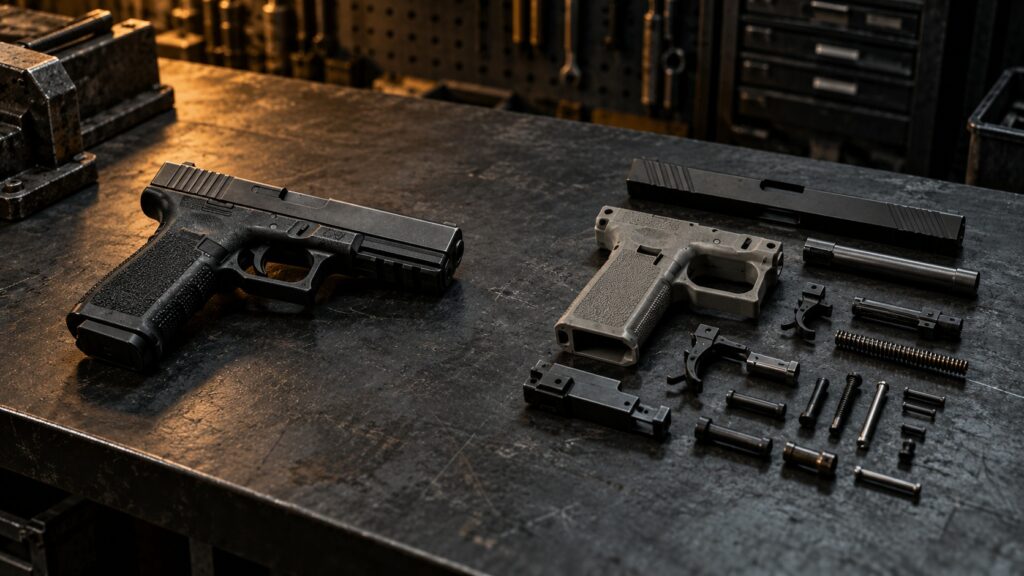
TLDR: A ghost gun is the common name for a privately made firearm that generally lacks a manufacturer-applied serial number. Unlike conventional firearms produced by licensed manufacturers, these guns may be made by individuals using unfinished components, commercially available parts, or 3D printing technology. Ghost gun kits are packages of firearm components, sometimes including an unfinished frame or receiver. While privately making a firearm for personal use can be legal under federal law, certain kits are regulated as firearms, and state laws may impose stricter restrictions. The Supreme Court’s 2025 decision in Bondi v. VanDerStok upheld federal regulation of certain weapon parts kits.
The term “ghost gun” sounds like something out of a crime thriller. In reality, it describes a category of firearms that has existed in one form or another for generations.
People have been making their own guns since long before 3D printers, online parts retailers, or modern gun-control debates.
What’s changed is the technology.
Commercially available components and modern manufacturing equipment have made privately manufactured firearms more accessible. That has attracted firearms enthusiasts who enjoy gunsmithing and building their own equipment. It has also attracted the attention of lawmakers and law enforcement agencies concerned about guns without serial numbers entering criminal markets.
Not every ghost gun is illegal. Not every firearm assembled from a kit qualifies as a ghost gun, either.
Understanding the distinction requires looking at how these firearms differ from conventional guns, what the term “ghost gun kit” means, and how federal law treats unfinished firearm components.
What Is a Ghost Gun?
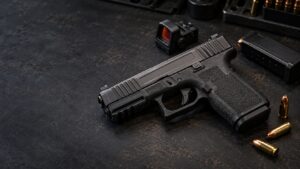
A ghost gun is generally a privately manufactured firearm without a serial number applied by a licensed firearm manufacturer.
The Bureau of Alcohol, Tobacco, Firearms and Explosives (ATF) uses the term privately made firearm, or PMF.
Under ATF’s definition, a privately made firearm is a firearm, including a frame or receiver, completed, assembled, or otherwise produced by someone other than a licensed manufacturer, without a manufacturer-applied serial number.
Most commercially manufactured firearms have serial numbers that help identify their manufacturer and facilitate tracing through sales records.
A ghost gun may lack that conventional identification trail.
That doesn’t necessarily make it impossible to investigate or identify. It does make traditional firearm tracing more difficult.
A privately made handgun can look and function much like a commercially manufactured handgun. The defining distinction isn’t necessarily its appearance, caliber, or operating mechanism.
It’s how the firearm was manufactured and identified.
Why Are They Called Ghost Guns?
The name comes from the difficulty of tracing an unserialized firearm through conventional manufacturing and dealer records.
When law enforcement recovers a commercially manufactured firearm, investigators can often use its serial number to identify the manufacturer, distributor, and first retail purchaser.
An unserialized privately made firearm generally lacks that starting point.
However, untraceable is not the same as unidentifiable.
Investigators may still use forensic evidence, recovered components, transaction records, witness information, and other investigative methods to establish a firearm’s history or connection to a crime.
The name “ghost gun” is also informal. It isn’t a universal legal classification covering every homemade firearm or unidentified weapon.
Ghost Guns vs. Regular Firearms
| Feature | Conventional commercial firearm | Typical ghost gun |
|---|---|---|
| Manufacturer | Licensed firearms manufacturer | Private individual |
| Serial number | Generally required | May lack a manufacturer-applied serial number |
| Federal manufacturing license | Required for licensed commercial production | Generally not required for lawful personal-use manufacture |
| Background check | Generally required when sold by a licensed dealer | Depends on the regulated components, transaction, and applicable law |
| Manufacturing method | Industrial production | Private fabrication, assembly, or 3D printing |
| Tracing | Usually begins with manufacturer and dealer records | Conventional tracing may be more difficult |
| Legal status | Depends on firearm and owner | Depends on firearm, owner, manufacturing circumstances, and jurisdiction |
One point is particularly important: A firearm doesn’t become a ghost gun merely because someone assembled it themselves.
Someone assembling a firearm using a legally acquired, serialized receiver is not necessarily creating an unserialized privately made firearm.
The serial-number status of the regulated component matters.
What Are Ghost Gun Kits?
Ghost gun kits are one of the main reasons privately made firearms have received so much attention.
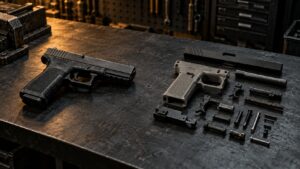
The phrase generally refers to packages of firearm components marketed for private completion or assembly, sometimes including an unfinished frame or receiver.
Historically, some kits were marketed as a convenient way for individuals to produce firearms outside the conventional factory-to-dealer purchasing process.
But “ghost gun kit” is a marketing and descriptive term, not a single legally defined product category.
Different kits can have very different regulatory classifications.
What’s Included in a Ghost Gun Kit?
A firearm-related parts kit can contain various components associated with a handgun or rifle.
Depending on the product, the package may contain an unfinished frame or receiver, other firearm components, accessories, or associated materials.
Some products are marketed as nearly complete firearm packages. Others are simply collections of replacement or assembly components.
A critical difference is whether the package contains a component or combination of components that federal law classifies as a firearm.
The ATF’s 2022 frame-or-receiver rule established that certain weapon parts kits fall within the federal definition of a firearm when they are designed to, or may readily, be completed or assembled into a functioning firearm.
In March 2025, the Supreme Court upheld the rule against a facial legal challenge.
That means sellers cannot assume a package is exempt from federal firearms regulations simply because the customer receives separate parts rather than a fully assembled gun.
Are Ghost Gun Kits the Same as Regular Firearm Build Kits?
No. The terms sometimes overlap, but they aren’t interchangeable.
A standard firearm build kit may contain components intended for use with a separately purchased, serialized receiver.
That receiver is typically treated as a firearm under federal law and subject to applicable transfer requirements.
A package marketed as a ghost gun kit may instead involve unfinished or privately manufactured components.
Whether those components are legally regulated depends on their actual characteristics and applicable law.
| Product or term | What it generally describes | Key distinction |
|---|---|---|
| Ghost gun kit | Components marketed for privately making a firearm | May contain components regulated as firearms |
| Rifle build kit | Collection of rifle components | Not inherently a ghost gun kit |
| Pistol build kit | Collection of handgun components | May be intended for use with a serialized receiver |
| 80% lower receiver | Commercial term for an unfinished receiver | The 80% label has no controlling legal significance |
| Complete serialized receiver | Regulated firearm component | Generally subject to ordinary federal firearm transfer rules |
| 3D-printed firearm | Firearm incorporating additively manufactured components | Not automatically unserialized or illegal |
This distinction is particularly relevant to AR-style rifle kits.
An AR-15 parts kit, for example, is not automatically a ghost gun kit. Its regulatory status depends on its contents, the status of any frame or receiver, and the circumstances of the transaction.
The product description alone is not enough.
What Is an 80% Lower Receiver?
The phrase “80% lower” became popular in the firearms industry as a way of describing an unfinished receiver.
The implication is that the component is partially manufactured but has not reached its final form.
However, the percentage is a commercial description, not a federal legal standard.
There is no universal rule that a receiver becomes a firearm precisely when it crosses an 80% completion threshold.
Instead, federal regulations consider whether an unfinished frame or receiver has reached a stage where it may readily be completed or converted into a functioning frame or receiver.
The ATF can also consider relevant circumstances and associated materials when making a classification.
The practical result is that two components marketed using similar terminology may not receive identical legal treatment.
For the current regulatory definitions, see the ATF’s summary of Final Rule 2021R-05F.
How Are Ghost Guns Made?
Privately made firearms are not limited to one production method.
Historically, firearms enthusiasts made their own guns through traditional metalworking and gunsmithing.
More recently, commercially supplied components and digital manufacturing technologies have expanded the category.
Three broad methods account for much of the modern discussion.
Privately Made Firearms Using Commercial Components
Some privately made firearms originate from unfinished components sold commercially.
The legal treatment of those components depends on whether they meet federal or state definitions of a firearm.
Commercial packaging does not automatically establish that a component is lawful to purchase, possess, or manufacture into a firearm.
Traditional Home Gunsmithing
Home gunsmithing existed long before the phrase “ghost gun” became common.
Some hobbyists have longstanding interests in firearms mechanics, machining, historical reproduction, and mechanical engineering.
Personal firearm manufacture has a history in the United States, although federal and state laws restrict what may be made, by whom, and under what circumstances.
Making firearms commercially is a separate activity subject to licensing requirements.
3D-Printed Ghost Guns
3D printing has added another dimension to the ghost gun debate.
Additive manufacturing allows certain physical components to be produced from digital designs rather than conventional industrial manufacturing methods.
Some privately made firearms incorporate 3D-printed parts. Others combine printed components with conventionally manufactured metal parts.
Contrary to popular portrayals, a 3D-printed gun is not necessarily made entirely of plastic.
Nor is every 3D-printed firearm undetectable.
Federal law separately restricts firearms that fail applicable detectability requirements, including requirements under the Undetectable Firearms Act.
The presence of 3D-printed components also does not automatically determine whether a firearm is legal.
Why Do People Make or Use Ghost Guns?
There isn’t one universal explanation.
People interested in privately made firearms can have very different motivations. Some are lawful enthusiasts interested in mechanical craftsmanship. Others may be interested in avoiding conventional firearm sales records or restrictions.
Those motivations should not be treated as equivalent.
1. Gunsmithing and Mechanical Interest
For many firearms enthusiasts, the appeal of private firearm manufacture is the technical challenge.
Firearms are mechanical systems. Understanding how they function can be interesting to people with backgrounds in machining, engineering, or gunsmithing.
Some hobbyists value the experience of creating something themselves.
That interest is not inherently criminal.
However, personal enthusiasm for a project does not exempt anyone from manufacturing restrictions or applicable safety requirements.
2. Customization and Personal Preferences
Firearm owners sometimes prefer specific configurations, features, or designs that differ from commercially available models.
Customization is common throughout the firearms industry, including among owners of conventionally manufactured, serialized guns.
A privately manufactured firearm can reflect personal design preferences, but customization alone does not make a gun a ghost gun.
An ordinary serialized firearm can also be extensively customized.
3. Privacy and Gun Ownership Records
Some individuals are attracted to the idea of private firearm manufacture because they prefer not to create the same transaction records associated with purchasing a complete firearm from a licensed dealer.
For those individuals, privacy is a significant motivation.
However, the legal ability to privately manufacture a firearm should not be confused with permission to evade laws, make false statements, or possess a weapon illegally.
State laws may impose serialization, reporting, or other requirements even when federal law permits certain private manufacturing activities.
4. Avoiding Background Checks or Legal Restrictions
This is the motivation that raises some of the greatest law enforcement concerns.
Unserialized firearms may appeal to individuals who want to acquire a gun outside the normal licensed-dealer process, including people who are legally prohibited from possessing firearms.
That is a serious distinction.
Making a firearm privately does not eliminate laws prohibiting certain individuals from possessing firearms.
A prohibited person does not become eligible to possess a weapon because it lacks a serial number or was produced outside a factory.
Similarly, manufacturing firearms for unlawful distribution or trafficking remains subject to criminal law.
5. Criminal Use and Trafficking
The absence of a conventional manufacturing and retail transaction history can make privately made firearms attractive in criminal markets.
Law enforcement agencies have reported substantial increases in suspected privately made firearms recovered during investigations.
That does not mean everyone making a firearm privately has criminal intentions.
It does mean the technology presents challenges for investigators, policymakers, and responsible gun owners.
How Common Are Ghost Guns in Crime?
According to the ATF’s National Firearms Commerce and Trafficking Assessment, law enforcement agencies recovered and reported 92,702 suspected privately made firearms between 2017 and 2023.
Reported annual recoveries increased from 1,629 in 2017 to 27,490 in 2023, an increase of approximately 1,600%.
The federal assessment also identified connections to approximately 1,700 homicides and more than 4,000 other violent crimes during the reporting period.
Source: U.S. Department of Justice, National Firearms Commerce and Trafficking Assessment.
These are significant numbers, but they require context.
The figures concern suspected privately made firearms reported to ATF by law enforcement agencies. They do not represent every privately made firearm in circulation, nor do they establish how many legally owned homemade firearms exist.
Changes in identification practices, law enforcement reporting, enforcement priorities, and firearm availability can also influence the reported totals.
Still, the substantial increase helps explain why ghost guns became a major subject of public safety policy and litigation.
Are Ghost Guns Legal in the United States?
The short answer is that some are legal and others are not.
Federal law does not impose a blanket prohibition on every privately made firearm.
ATF states that an individual may generally make a firearm for personal use without obtaining a federal manufacturer’s license, provided the person is legally eligible and the firearm complies with applicable requirements.
However, that principle has important limitations.
A person cannot legally possess a firearm merely because it was privately made if that person is otherwise prohibited from firearm possession.
Manufacturing firearms as a business generally requires federal licensing. Certain categories of firearms are subject to additional federal restrictions.
State laws may be considerably stricter.
The 2022 ATF Ghost Gun Rule
In 2022, ATF adopted Final Rule 2021R-05F, addressing the definition of a firearm frame or receiver and related identification requirements.
The rule clarified that certain partially complete frames, receivers, and weapon parts kits may qualify as firearms under federal law.
This matters because federally regulated firearms are subject to requirements governing licensed manufacturers and dealers, including applicable serialization, recordkeeping, and background-check procedures.
The rule also addressed how licensed firearms businesses handle privately made firearms acquired into their inventory.
It did not declare every privately manufactured firearm illegal.
What Did the Supreme Court Decide About Ghost Gun Kits?
On March 26, 2025, the Supreme Court decided Bondi v. VanDerStok.
The Court ruled 7-2 that the federal Gun Control Act can cover certain weapon parts kits and unfinished frames or receivers, rejecting a facial challenge to ATF’s 2022 rule.
Justice Neil Gorsuch wrote the majority opinion.
The decision established that certain items can fall within the statutory definition of a firearm even when they are not sold as completed, operational weapons.
However, the ruling did not establish that every firearm part, unfinished receiver, or privately made firearm must automatically be regulated in the same way.
The distinction remains based on the applicable statutory definitions and the characteristics of the particular item.
Read the Supreme Court’s opinion in Bondi v. VanDerStok.
State Ghost Gun Laws Can Be Stricter
Federal firearm law establishes nationwide requirements, but states can impose additional restrictions.
Some states require serialization of privately made firearms. Others restrict unfinished frames, receivers, possession, manufacturing, or transfers.
California provides a particularly clear example.
Its laws impose extensive restrictions on unserialized firearms and certain firearm precursor parts. An updated California Department of Justice reference guide addresses additional laws effective January 1, 2026, including restrictions involving firearm manufacturing technologies.
Maryland, New York, Illinois, and other states have also adopted laws addressing privately made or unserialized firearms.
These laws differ in definitions, restrictions, exceptions, and enforcement.
A firearm that can legally be possessed in one state may create legal problems in another.
The California Department of Justice Ghost Gun Laws Reference Guide illustrates how detailed these restrictions can become.
Are Ghost Guns More Dangerous Than Regular Guns?
A ghost gun is not automatically more powerful, more lethal, or mechanically different from a comparable conventional firearm.
Its capabilities depend on the actual design, caliber, materials, manufacturing quality, and condition.
However, privately manufactured firearms introduce several concerns worth distinguishing.
Mechanical Reliability and Safety
Commercial firearms are typically manufactured under established production processes and may undergo standardized inspection and testing.
Privately made firearms may not receive the same quality controls.
Manufacturing defects, unsuitable materials, or improperly fitted components can create serious safety risks.
This concern is particularly relevant when a firearm incorporates untested or improvised components.
An unreliable firearm may fail when needed or malfunction in a way that endangers the user and bystanders.
Lack of Conventional Traceability
The absence of a manufacturer-applied serial number can complicate criminal investigations.
Tracing a firearm is not the only investigative method available, but it is an established tool for identifying the commercial distribution history of recovered weapons.
Privately made firearms may lack that history.
Legal Uncertainty
An owner who misunderstands the classification of a component or the law governing privately made firearms can face legal consequences even without intending to commit a crime.
The legal status of a firearm can depend on how it was manufactured, the owner’s legal eligibility, where it is possessed, and how it is transferred.
For lawful owners, that uncertainty is itself a significant risk.
Common Ghost Gun Myths
A few claims appear repeatedly in discussions of ghost guns, often without much qualification.
| Claim | Reality |
|---|---|
| All ghost guns are illegal | False. Some privately made firearms are lawful, subject to applicable laws |
| Ghost guns are always 3D printed | False. Traditional manufacturing and commercial components are also involved |
| Ghost guns cannot be traced at all | Misleading. Missing serial numbers complicate conventional tracing but do not eliminate forensic investigation |
| Every gun kit is a ghost gun kit | False. Ordinary parts kits may be intended for serialized firearms |
| An 80% lower is automatically legal | False. The term is not the controlling legal standard |
| The Supreme Court banned all ghost guns | False. The Court upheld federal authority to regulate certain kits and components |
| Ghost guns cannot be detected by metal detectors | False. Many contain metal, and federal detectability laws apply |
| Homemade guns are exempt from firearm ownership restrictions | False. Prohibited-person laws and other firearm restrictions still apply |
The recurring mistake is treating “ghost gun” as though it describes one specific product with one set of legal rules.
It doesn’t.
Ghost Gun Frequently Asked Questions
Is It Illegal to Own a Ghost Gun?
Not necessarily. Federal law permits certain privately made firearms, but state laws may impose additional restrictions. Legal ownership depends on the firearm, the individual, and the applicable jurisdiction.
Do Ghost Guns Have Serial Numbers?
Many privately made firearms lack manufacturer-applied serial numbers. However, some privately made firearms may receive serial numbers through lawful procedures. Not every privately made firearm remains unserialized.
Are Ghost Gun Kits Illegal?
Some weapon parts kits are regulated as firearms under federal law. Whether a particular kit is legal to sell, acquire, or possess depends on its contents and applicable federal and state restrictions.
Are Ghost Gun Kits the Same as 80% Lowers?
No. An 80% lower generally refers to an unfinished receiver. A ghost gun kit may contain multiple components. The two terms are related but describe different things.
Do You Need a Background Check for a Ghost Gun Kit?
If a kit qualifies as a firearm under federal law and is transferred through a licensed dealer, applicable firearm transfer and background-check requirements generally apply. Other transactions and state laws may have additional requirements.
Can a Ghost Gun Be Used for Self-Defense?
A privately made firearm may be possessed for lawful purposes, including self-defense, where permitted by law. However, owners must comply with firearm possession and carry laws. Mechanical reliability and safe operation also matter.
The absence of a serial number does not create special self-defense rights or exemptions.
Can Ghost Guns Be 3D Printed?
Yes. Some privately made firearms incorporate 3D-printed components. However, they remain subject to applicable firearm laws, including restrictions involving detectability and any state-specific manufacturing rules.
Can Someone Sell a Ghost Gun?
The rules governing transfers of privately made firearms are complex. Federal law distinguishes personal manufacturing from engaging in the business of manufacturing firearms. Licensed dealers have additional requirements for privately made firearms acquired into inventory, and some states restrict transfers of unserialized firearms.
Anyone considering a transfer should verify the applicable law before proceeding.
The Hard Baseline on Ghost Guns
Ghost guns sit at the intersection of two longstanding realities.
Americans have a history of privately manufacturing firearms for lawful personal use. At the same time, the government has an established interest in regulating commercial firearm manufacturing, transfers, and possession by prohibited individuals.
Modern ghost gun kits and manufacturing technology have made those issues harder to separate.
The most important distinctions are straightforward.
A privately made firearm is not automatically illegal. A commercially marketed parts kit is not automatically exempt from firearm regulations. An unfinished component is not necessarily outside federal law simply because someone calls it an 80% lower.
And a firearm without a serial number is not invisible to law enforcement.
For firearms enthusiasts, the responsible approach is to understand the applicable rules, recognize the risks associated with privately manufactured equipment, and avoid relying on outdated claims about legal loopholes.
The bottom line: What matters is the actual firearm or component, how it was manufactured, who possesses it, and the laws that apply. The phrase “ghost gun” alone doesn’t answer any of those questions.
This article provides general educational information about U.S. firearms law and technology. It is not legal advice. Firearms regulations change, and readers should verify current federal, state, and local requirements before making decisions involving privately manufactured firearms.
Jared Fischer

Tactical Gear Armory is a group of tactical gear geeks! We specialize in everything from martial arts to AR-15's and other firearms.