Byrna vs. Glock: Should You Choose a Less-Lethal Launcher or a Real Gun for Self-Defense?
When it comes to protecting yourself and your family, one of the most important decisions you can make is whether to carry a traditional firearm or choose a less-lethal alternative.
For many Americans, that decision increasingly comes down to Byrna vs. Glock.
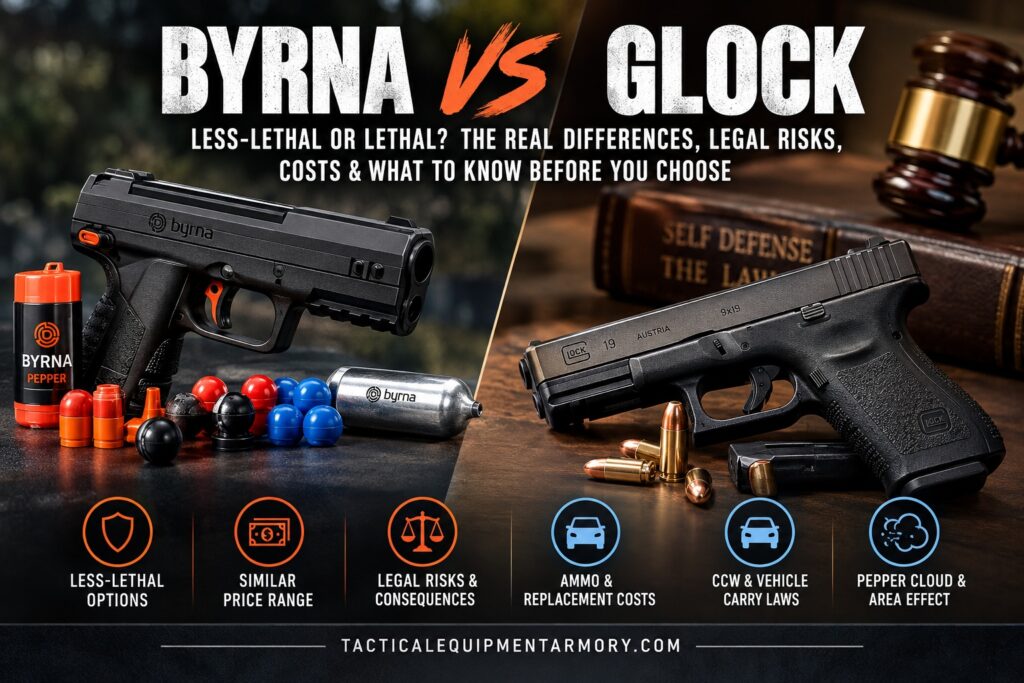
Glock manufactures some of the world’s most recognizable defensive handguns, including the Glock 19. Byrna, meanwhile, produces CO2-powered launchers that resemble conventional pistols but fire solid kinetic or chemical-irritant projectiles rather than bullets.
Surprisingly, these two options can cost roughly the same amount. A Byrna launcher can run anywhere from approximately $400 to nearly $600, while a new Glock 19 typically costs several hundred dollars more, depending on the generation and dealer.
But the price difference is arguably the least important consideration.
A Glock is designed to deliver potentially lethal force. A Byrna is designed to provide a means of defending yourself without necessarily inflicting a fatal injury.
Both have advantages, limitations, and legal implications that every prospective owner should understand.
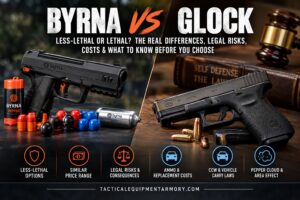
Byrna vs. Glock: Quick Comparison
| Feature | Byrna Launcher | Glock 19 (9mm) |
|---|---|---|
| Weapon type | CO2-powered less-lethal launcher | Semiautomatic firearm |
| Typical purchase price | $399–$580 | Approximately $600–$745 for a new Gen6 |
| Ammunition | Kinetic, pepper, or chemical-irritant projectiles | Live 9mm ammunition |
| Lethality | Lower risk of fatal injury, but death is possible | Potentially lethal |
| Background check | Generally not required | Required for purchases through federally licensed dealers |
| Concealed carry permit | Generally not required under firearm licensing laws; local weapon restrictions apply | Depends on state law |
| Vehicle carry | Generally permitted in many jurisdictions, subject to restrictions | Depends on state firearm and vehicle carry laws |
| Typical defensive ammunition cost | Approximately $5–$6 per chemical projectile | Often under $2 per defensive cartridge |
| Practice ammunition | Approximately $0.42–$0.84 per disposable training round | Approximately $0.24–$0.35 per standard range cartridge |
| Area effect | Chemical rounds disperse an irritant cloud | Bullets affect their physical path and anything they strike |
| Potential legal consequences | Criminal charges and civil liability remain possible | Serious criminal and civil consequences if force is unjustified |
Prices are approximate U.S. figures as of November 2026. Applicable laws vary by jurisdiction.
What Is the Difference Between a Byrna and a Glock?
Despite their similar appearance, Byrna launchers and Glock handguns are fundamentally different defensive weapons.
How a Glock Works
A Glock is a conventional semiautomatic firearm. Models such as the Glock 19 fire live 9mm ammunition, using the energy of a cartridge to propel a bullet down the barrel.
Glock pistols are known for durability, reliability, and widespread use among civilian gun owners, police departments, and military organizations.
Their primary defensive advantage is the ability to deliver substantial force against a dangerous attacker.
However, using a firearm against another human being is an extraordinary decision. A gunshot can cause permanent injury or death, even when the person firing did not intend a fatal outcome.
A missed shot also presents significant danger because a bullet can travel beyond its intended target, penetrate building materials, or strike an innocent bystander.
How a Byrna Works
A Byrna launcher uses compressed carbon dioxide rather than gunpowder to propel specially designed projectiles.
Depending on the model and ammunition selected, these projectiles can produce pain through physical impact or disperse chemical irritants intended to impair an attacker’s ability to continue an assault.
Common Byrna models include:
- Byrna SD: A popular introductory launcher priced around $399.99.
- Byrna LE: A larger launcher with a retail price around $499.99.
- Byrna CL: A compact option priced around $549.99.
- Byrna CL-XL: A compact, higher-performance launcher priced around $579.99.
Most Byrna launchers use .68-caliber projectiles, while the compact CL series uses .61-caliber ammunition. The two sizes are not interchangeable.
Unlike a Glock, a Byrna does not use conventional firearm cartridges. Consequently, it generally falls outside federal firearm classifications and associated purchasing requirements.
That does not mean it is harmless or completely unregulated.
The Biggest Difference: The Legal Consequences of Using Deadly Force
Perhaps the strongest argument for considering a Byrna instead of a Glock has relatively little to do with the equipment itself.
It has to do with what happens after you use it.
What Happens if You Shoot Someone With a Glock in Self-Defense?
American self-defense laws generally recognize a person’s right to defend themselves against an imminent unlawful threat.
But the fact that someone was frightened, confronted, or threatened does not automatically justify shooting another person.
In many jurisdictions, using deadly force requires a reasonable belief that such force is necessary to prevent imminent death, serious bodily injury, or certain other specifically recognized serious crimes.
The rules differ by state.
For example, Florida Statute 776.012 distinguishes between situations justifying nondeadly force and those justifying deadly force.
Even in states with Stand Your Ground laws, the use of deadly force must satisfy applicable legal requirements. Those laws are not permission to shoot someone merely because they are trespassing, acting aggressively, insulting you, or refusing to leave.
If you use a Glock in self-defense, investigators may examine:
- Whether the attacker posed an imminent and sufficiently serious threat.
- Whether your belief that deadly force was necessary was reasonable.
- Whether you provoked or escalated the confrontation.
- Whether the threat had ended before you used force.
- Whether your actions endangered innocent bystanders.
- Whether retreat was legally required or reasonably available under applicable law.
Depending on the circumstances, an unjustified shooting can result in charges ranging from aggravated assault to manslaughter or murder.
Even when criminal charges are never filed, a shooting can involve police investigations, attorney fees, lost employment, emotional distress, and potentially civil litigation.
A justified self-defense shooting is not necessarily a consequence-free experience.
Does Using a Byrna Reduce Your Legal Risk?
Potentially, yes. But there are important qualifications.
Because a Byrna is intended to deliver less-lethal force, its use may be evaluated differently from the discharge of a conventional firearm.
For example, certain situations might legally justify a reasonable amount of nondeadly defensive force without satisfying the much stricter requirements for deadly force.
That distinction can be extremely important.
Imagine an attacker physically assaults someone but does not present an imminent threat of death or serious bodily injury. Depending on the circumstances and applicable law, using a reasonable degree of nondeadly force might be justified even though firing a handgun would not be.
However, this does not mean deploying a Byrna is automatically legally defensible.
A launcher can still be considered a dangerous weapon, and the manner in which it is used can affect whether the resulting force is legally classified as deadly or nondeadly.
Misusing a Byrna could lead to criminal charges involving assault, battery, reckless endangerment, or unlawful weapons possession.
A person injured by a Byrna projectile could also pursue a civil lawsuit.
The practical difference is that a properly used less-lethal device may reduce the likelihood of a fatal outcome and, in appropriate circumstances, provide a more proportionate defensive option.
The critical point: Less-lethal does not mean legally consequence-free. It means the potential consequences may be less severe, depending on what happened and whether the use of force was justified.
Byrna vs. Glock: Concealed Carry and Permit Requirements
Another major reason people consider Byrna launchers is the relative simplicity of ownership and carry.
Do You Need a CCW Permit for a Glock?
That depends on where you live.
Many states now permit eligible adults to carry concealed handguns without obtaining a traditional concealed carry permit.
However, other states continue to require permits, and even permitless-carry states impose eligibility requirements and restrictions on certain locations.
Purchasing a Glock from a federally licensed firearms dealer generally requires a background check. Federal law also prohibits licensed dealers from selling handguns to people under 21.
Some states impose additional requirements, such as waiting periods, purchasing permits, training, or firearm-specific restrictions.
Traveling between states introduces another layer of complexity because laws governing concealed carry, transportation, and permit reciprocity can differ.
Do You Need a Concealed Carry Permit for a Byrna?
Generally, no conventional firearm concealed carry permit is required to own or carry a Byrna where its possession and carry are otherwise lawful.
Byrna launchers are not classified as firearms under federal law, and Byrna states that its launchers are generally legal to own throughout the United States without a firearm permit.
This makes them attractive to people who want a defensive option without navigating the same licensing process required for firearms in some states.
However, there is an important distinction between being legal to own and legal to carry concealed in a particular place.
State and municipal laws can regulate dangerous weapons, air-powered launchers, imitation firearms, and chemical irritants independently of firearm licensing rules.
For example, Byrna identifies restrictions affecting New York City, Washington, D.C., Portland, Oregon, and other jurisdictions.
Some jurisdictions also impose special restrictions on the type of ammunition that can be possessed or used.
A Byrna should never be treated as universally legal to carry simply because it is not a firearm.
Can You Keep a Byrna or Glock in Your Car?
Vehicle carry laws are another major consideration.
For Glock owners, the legality of keeping a loaded handgun in a vehicle depends on state law, licensing status, and how the firearm is stored.
Some states allow eligible people to keep a loaded handgun inside a vehicle without a permit. Others impose restrictions or require the firearm to be unloaded and secured under applicable transport rules.
Federal law provides certain protections for interstate transportation of unloaded, secured firearms, but these protections have specific conditions.
For Byrna owners, keeping a launcher in a personal vehicle is generally less complicated in many jurisdictions because conventional firearm transportation laws often do not apply.
Nevertheless, state and local rules may still restrict carrying a launcher, transporting chemical projectiles, or possessing weapons in particular places.
A Byrna inside a vehicle is not automatically exempt from all weapons laws.
Regardless of which device you own, leaving an unsecured weapon in a parked vehicle creates theft and unauthorized-access risks.
Important State Restrictions on Byrna Ammunition
The launcher and its ammunition must be considered separately.
For example:
| Jurisdiction | Notable Byrna restrictions |
|---|---|
| California | Byrna launchers and nonchemical kinetic rounds may be permitted, but chemical projectile weapons face significant restrictions |
| New York State | Launchers and kinetic projectiles are generally available outside restricted localities; chemical rounds are restricted |
| New York City | Significant local restrictions apply |
| Washington, D.C. | Byrna lists major product and shipping restrictions |
| Wisconsin | Byrna Max projectiles are restricted |
| Michigan | Byrna Max projectiles are restricted |
These examples are not a complete legal guide. Shipping restrictions also do not necessarily establish the full scope of local possession or carry laws.
Before purchasing a Byrna for concealed carry or vehicle defense, verify the laws governing the particular model, ammunition type, and locations where you intend to carry it.
The Byrna Pepper Cloud: Why a Near Miss Can Still Have an Effect
One of the most interesting differences between Byrna and Glock is something that receives relatively little attention in conventional firearm comparisons.
A chemical Byrna projectile does not necessarily need to strike an attacker directly to expose them to its irritant.
This is a meaningful distinction.
How Byrna Pepper Projectiles Work
Byrna offers several types of ammunition.
Its Pepper projectiles contain oleoresin capsicum (OC) and PAVA, while Byrna Max rounds contain an enhanced mixture of irritants that includes CS tear gas.
Unlike a solid kinetic round, a chemical projectile is designed to rupture upon impact.
When it breaks, the powdered irritant disperses into the surrounding air.
According to Byrna’s product guidance, Pepper projectiles can create an irritant cloud approximately three to five feet wide.
That means the chemical effect is not necessarily limited to the exact point where the projectile strikes.
Why This Matters Compared With a Missed Bullet
If someone fires a Glock and misses the intended target, the bullet continues traveling until it encounters something that stops it.
Depending on the environment, that could mean a wall, vehicle, window, or innocent person.
A missed firearm shot can have potentially fatal consequences far beyond the confrontation itself.
A Byrna chemical projectile behaves differently.
If a chemical round breaks against a nearby surface, the resulting cloud may expose a person who was not directly struck.
This creates the possibility of a deterrent effect from a near miss, rather than requiring direct physical contact in every situation.
Importantly, not every missed projectile will rupture in a useful location, and chemical exposure does not guarantee that an attacker will stop.
The difference is not that missing with a Byrna is safe. It is that a near miss with a chemical projectile can produce a different kind of effect than a missed conventional bullet.
Could One Byrna Round Affect Multiple Attackers?
Potentially.
Because chemical irritants disperse through the air, more than one person can be exposed to a cloud produced by a single projectile.
If multiple individuals are close to the impact area, they may experience irritation even though only one projectile was discharged.
This is an important distinction from conventional handgun ammunition, which does not deliberately disperse an incapacitating chemical agent into a surrounding area.
However, the effect is indiscriminate.
An irritant cloud can also expose innocent bystanders, family members, and the person using the launcher.
Air movement, obstacles, enclosed spaces, and individual susceptibility can all influence the result.
Chemical projectiles should never be considered reliable tools for simultaneously stopping multiple attackers, nor should their area effect be used recklessly in occupied spaces.
An unintended chemical exposure could also have legal consequences.
Is a Byrna Really Non-Lethal?
Although Byrna is frequently marketed using the term non-lethal, the more accurate description is less-lethal.
That distinction matters.
A projectile launched at substantial speed can cause serious injuries, particularly if it strikes a vulnerable part of the body.
Potential consequences include eye injuries, facial trauma, internal injury, and, under certain circumstances, death.
Chemical irritants can also create significant respiratory distress, particularly for vulnerable individuals.
Therefore, choosing a Byrna reduces certain risks associated with conventional firearms but does not eliminate the possibility of a tragic outcome.
It is also important to understand that less-lethal projectiles do not reliably incapacitate everyone.
A determined or highly agitated attacker may continue an assault despite exposure to pepper irritants or being struck by kinetic rounds.
This is one reason a Byrna cannot simply be considered a direct substitute for a Glock in every defensive situation.
Byrna vs. Glock: How Much Does the Ammunition Cost?
The purchase price is only the beginning.
Ammunition, training, and other consumables affect the actual cost of ownership.
Byrna Ammunition Replacement Costs
Byrna ammunition is available in several configurations, with substantial price differences between chemical projectiles and practice rounds.
| Byrna ammunition | Example package price | Approximate cost per round |
|---|---|---|
| Pepper projectiles | $24.99 for 5 | $5.00 |
| Max chemical projectiles | $29.99 for 5 | $6.00 |
| Kinetic projectiles | $49.99 for 95 | $0.53 |
| Eco-Kinetic training rounds | $39.99 for 95 | $0.42 |
| Pro Training projectiles | $79.99 for 95 | $0.84 |
Prices reflect manufacturer listings and exclude tax, shipping, and applicable discounts.
The biggest surprise for prospective owners is often the cost of defensive chemical ammunition.
Replacing five Byrna Pepper projectiles costs approximately $25, while replacing five Byrna Max rounds costs about $30.
That is relatively expensive compared with conventional handgun ammunition.
However, Byrna owners can practice with less expensive training projectiles rather than using chemical ammunition for every session.
Some solid kinetic projectiles may also be recoverable and reusable when undamaged and appropriate for training.
Don’t Forget the CO2 Cartridges
Byrna launchers also require compressed CO2 cartridges.
A typical manufacturer-listed 10-pack of 8-gram or 12-gram CO2 cartridges costs approximately $19.99, depending on the product.
That works out to roughly $2 per cartridge.
The number of shots obtainable from each cartridge varies by launcher model and operating conditions.
An unpunctured cartridge can generally remain installed for extended storage in compatible Byrna launchers. Once punctured, however, CO2 pressure can gradually dissipate.
Owners should follow the manufacturer’s guidance for replacement and maintenance.
Chemical ammunition also has a limited shelf life and may require periodic replacement even if it has never been used.
Glock 9mm Ammunition Costs
Conventional 9mm ammunition is generally considerably cheaper per round.
Typical pricing includes:
- Standard FMJ practice ammunition: approximately $0.24–$0.35 per round.
- Premium defensive ammunition: often approximately $0.60–$1.50 or more per round, depending on the load and quantity.
A 50-round box of ordinary range ammunition might cost approximately $12–$18.
This makes high-volume target practice with a Glock significantly less expensive on a per-shot basis than practicing with many disposable Byrna projectiles.
Of course, the total expense of firearm ownership can also include range fees, professional instruction, cleaning supplies, secure storage, licensing fees where applicable, and other equipment.
Which Is Cheaper to Own?
A Byrna may have a lower initial purchase price than a new Glock 19 Gen6, but its defensive chemical ammunition is substantially more expensive per shot.
A Glock generally offers cheaper practice ammunition, although firearm training and range access can increase overall expenses.
For someone who trains frequently, the difference in ammunition costs can become significant.
For someone primarily concerned with having a less-lethal defensive option available, the higher cost of occasional chemical-ammunition replacement may be acceptable.
Is a Glock More Effective Than a Byrna for Self-Defense?
This is where the comparison becomes more complicated.
A Glock and a Byrna are intended to offer different levels of force.
When a Glock Has the Advantage
A conventional firearm can deliver substantially greater force than a CO2-powered less-lethal launcher.
In a situation involving an imminent threat of death or serious bodily injury, that distinction may be decisive.
A person armed with a firearm or another deadly weapon may present a threat that a less-lethal launcher cannot reliably stop.
Even if a chemical irritant causes discomfort, it may not immediately prevent an attacker from continuing.
A Glock provides a lethal-force capability that a Byrna is not designed to match.
However, greater force does not guarantee that a confrontation will end immediately, and firearm use introduces a far higher risk of fatal injury.
When a Byrna Has the Advantage
A Byrna may be more attractive when the owner’s goal is to have a defensive option that does not inherently involve shooting someone with a conventional bullet.
Its advantages include:
- Lower risk of fatal injury than conventional firearm ammunition.
- Generally fewer firearm-related purchasing and licensing requirements.
- Less complicated possession and transportation in many jurisdictions.
- Chemical projectiles that can expose an attacker without a direct hit.
- An alternative to deadly force in situations where reasonable nondeadly defensive force is legally justified.
For people who are uncomfortable with the responsibility of carrying a lethal weapon, those considerations can be particularly persuasive.
But there are trade-offs.
Byrna launchers depend on functioning CO2 systems, compatible projectiles, and other mechanical components. Chemical irritants can be influenced by environmental conditions and individual reactions.
Furthermore, a Byrna’s firearm-like appearance can cause an attacker, witness, or responding police officer to mistake it for a real gun.
That misunderstanding could escalate a confrontation or provoke a deadly response.
A less-lethal launcher is therefore not automatically the safest choice in every situation.
The Problem With Carrying Something That Looks Like a Real Gun
This is one of the Byrna’s most significant disadvantages.
Many Byrna launchers closely resemble conventional handguns.
That appearance may lead someone to believe the device is a firearm.
Unfortunately, the person making that assumption might be an armed attacker or a police officer responding to an emergency.
In either case, a mistaken identification could have devastating consequences.
For this reason, the fact that a Byrna is not legally classified as a firearm does not mean it will be recognized as less-lethal during a confrontation.
Owners should avoid unnecessary display, threatening gestures, or anything that could cause other people to believe a firearm is being brandished.
A Byrna should be handled with the seriousness appropriate to any weapon capable of causing injury.
Should You Buy a Byrna Instead of a Glock?
There is no universally correct answer.
The choice depends on your legal circumstances, personal comfort, willingness to train, and expectations for defensive effectiveness.
A Byrna Might Make More Sense If:
You want an option that carries a lower risk of causing death than a conventional handgun.
You prefer to avoid firearm licensing requirements where possible and understand that separate weapons laws may still apply.
You are concerned about the potentially irreversible consequences of shooting someone.
You want a device designed to provide a less-lethal alternative in situations where defensive force is legally justified.
A Glock Might Make More Sense If:
You are legally eligible and comfortable owning and responsibly carrying a firearm.
You want the capability to respond to a threat involving potentially deadly force.
You understand the legal standard for using a firearm defensively and are prepared to obtain appropriate training.
You recognize that the decision to fire may permanently change several people’s lives, including your own.
Could Owning Both Make Sense?
Some gun owners may find value in having a less-lethal defensive option in addition to a conventional firearm.
However, owning multiple weapons also increases the importance of understanding applicable laws, storage requirements, training needs, and the risks associated with each device.
No defensive tool should be treated as a substitute for situational awareness, avoiding confrontations, and safely disengaging whenever possible.
Byrna vs. Glock: Frequently Asked Questions
Is a Byrna as powerful as a Glock?
No. A Glock fires conventional ammunition designed to deliver substantially greater force. A Byrna fires less-lethal projectiles intended to deter or disrupt an attacker through impact or chemical irritation. The two weapons are not equivalent in power or intended effect.
Can a Byrna kill someone?
Yes. Although Byrna launchers are designed to reduce the likelihood of fatal injuries, their projectiles can cause serious injury or death under certain circumstances. Less-lethal does not mean incapable of killing.
Can you legally carry a Byrna without a concealed carry permit?
Generally, a firearm concealed carry permit is not required because Byrna launchers are not federally classified as firearms. However, state and local laws may separately regulate the concealed carry of dangerous weapons and air-powered launchers.
Can you keep a Byrna in your car?
In many U.S. jurisdictions, yes. However, local weapons laws and restrictions on chemical ammunition may still apply. Vehicle carry laws should be checked before traveling.
Are Byrna pepper balls legal in every state?
No. Some jurisdictions, including California and New York, restrict chemical projectiles even where Byrna launchers and nonchemical ammunition may be legally available.
Does a Byrna pepper projectile have to hit an attacker?
Not necessarily. Pepper projectiles are designed to burst on impact and disperse a chemical irritant cloud, potentially exposing someone near the impact location. However, the round must rupture appropriately, and the resulting exposure may not reliably stop the person.
Can one Byrna pepper ball affect multiple people?
Yes, potentially. More than one person may be exposed to a dispersed irritant cloud. Unfortunately, that includes innocent bystanders and the person operating the launcher. Chemical irritants do not distinguish between attackers and noncombatants.
Is Byrna ammunition more expensive than Glock ammunition?
Usually, yes, when comparing Byrna chemical projectiles with conventional 9mm ammunition. A Byrna Pepper round costs approximately $5, while standard 9mm practice ammunition often costs less than $0.35 per round. Byrna training projectiles are considerably cheaper than its chemical rounds.
Can you go to jail for shooting someone with a Byrna?
Yes. A Byrna is still a weapon. Unjustified use can result in criminal charges, and serious injuries may expose the user to additional legal consequences and civil liability.
Is using a Byrna more legally defensible than using a Glock?
It can be, depending on the circumstances. Legally justified nondeadly force may be permissible in some situations where deadly force is not. However, the classification of force depends on how the weapon was used, the injuries caused or risked, and the applicable law. A Byrna does not provide automatic protection from prosecution.
Final Verdict: Byrna vs. Glock Comes Down to More Than Stopping Power
The Byrna vs. Glock debate is ultimately about the type of force a person is willing and legally permitted to use.
A Glock provides the capability to respond to potentially deadly threats with lethal force. For some defensive situations, that capability matters enormously.
But firearm ownership comes with a responsibility that cannot be overstated. Every defensive shooting carries the possibility of death, lifelong injury, investigation, and serious legal consequences.
A Byrna offers a different approach.
Its less-lethal projectiles create the possibility of deterring an attacker while reducing the likelihood of a fatal outcome. Chemical rounds can also disperse beyond their precise impact location, potentially creating an effect even when a projectile does not strike the intended person directly.
At the same time, a Byrna is not harmless, cannot guarantee incapacitation, and does not provide immunity from legal consequences.
For someone who wants a defensive option but is reluctant to accept the potentially irreversible consequences of using a conventional firearm, a Byrna is worth serious consideration.
For someone primarily concerned with stopping an imminent deadly threat, however, a less-lethal launcher should not be mistaken for a firearm with equivalent capabilities.
Ultimately, responsible self-defense is not simply about choosing the most powerful weapon. It is about understanding the threat, the law, the limitations of your equipment, and the consequences of your decisions.
Disclaimer: This article is intended for general educational purposes and does not constitute legal advice. Laws governing firearms, less-lethal weapons, concealed carry, vehicle transportation, and defensive force vary by jurisdiction and can change. Consult current state and local laws or a qualified attorney before purchasing, carrying, or using any defensive weapon.
References and Further Reading
- Byrna Official Product Catalog and Launcher Specifications
- Byrna Pepper Projectile Specifications and Pricing
- Byrna Legal Guide
- Byrna Shipping and Ammunition Restrictions
- Glock Official Website
- Cornell Law School: Self-Defense
- Florida Statute 776.012: Justifiable Use of Force
- USCCA: Concealed Carry and Permitless Carry Laws
Jared Fischer

Tactical Gear Armory is a group of tactical gear geeks! We specialize in everything from martial arts to AR-15's and other firearms.