Charlie Kirk Shooting Evidence: What the Ballistics, DNA, and Court Testimony Actually Show
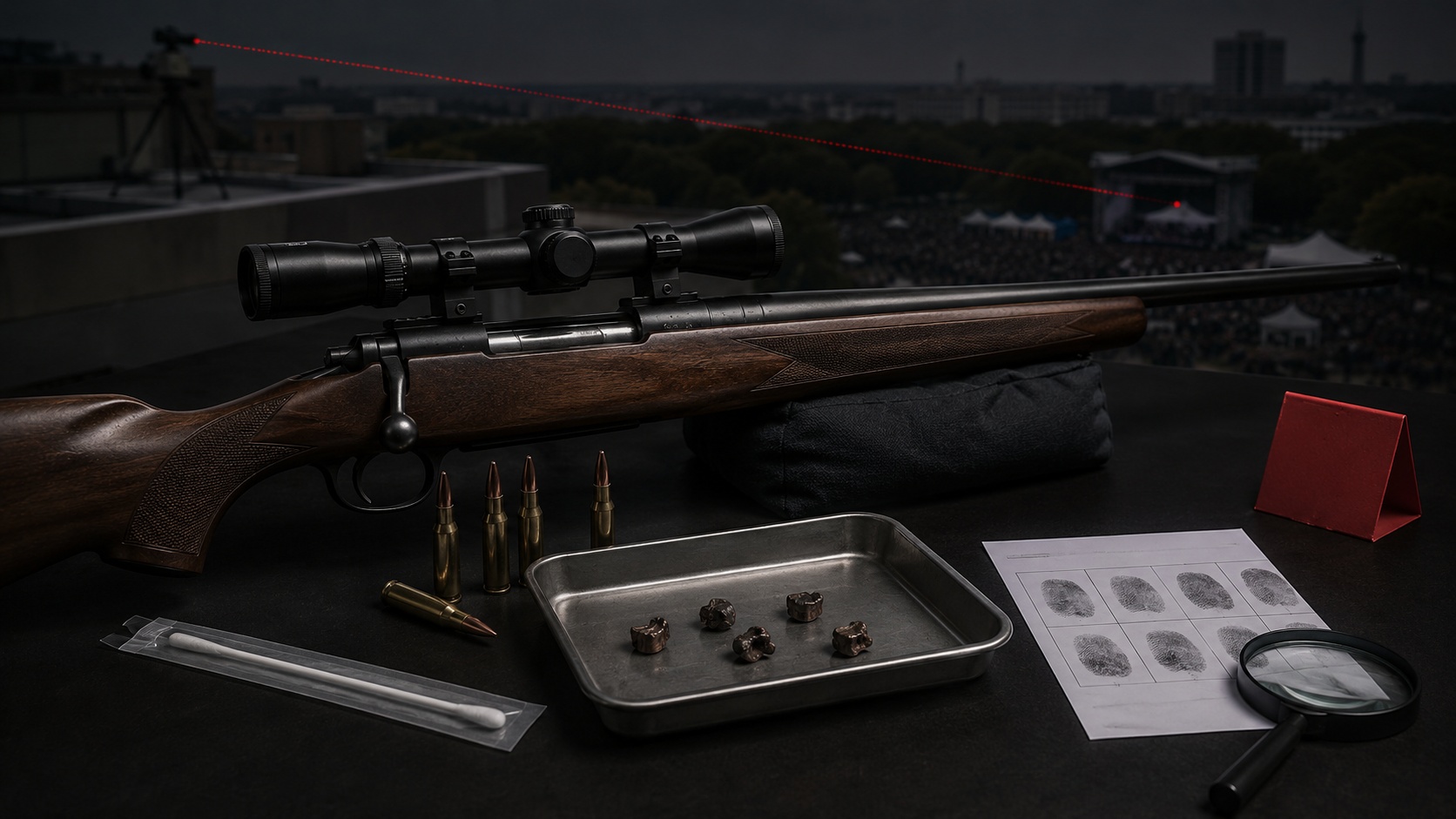
Accuracy note: This article reflects the public record available through August 26, 2026. Tyler Robinson is accused, has not been convicted, and is entitled to the presumption of innocence. The court is scheduled to hear final probable-cause arguments on September 1, 2026.
Charlie Kirk’s assassination generated an information fight almost as fast as it generated a manhunt. Some people accepted every government statement on contact. Others treated every incomplete answer as proof of a frame-up.
Neither approach is useful.
A serious preparedness mindset starts with evidence discipline. You identify what is known, mark what is uncertain, and avoid upgrading possibility into fact. That standard matters even more when a politically motivated killing attracts claims about hidden shooters, manipulated evidence, foreign intelligence services, and entire ethnic or religious groups.
This review focuses on the firearm and forensic questions at the center of the dispute. Could a .30-06 bullet stop inside a neck without exiting? Did the recovered bullet fail to match the rifle? Was the shot too difficult for Tyler Robinson? Were his fingerprints or DNA suspiciously degraded? And do any of those issues support claims that Israel, Jewish donors, Turning Point USA insiders, or some other organization arranged the killing?
The short answer is blunt. There are legitimate unanswered questions, but no known law of ballistics or forensic contradiction makes the prosecution’s account impossible. Several viral claims also misstate what the laboratory witnesses actually said.
BLUF: What the Public Evidence Supports
The prosecution does not have a conclusive individual match between the damaged bullet jacket recovered at autopsy and the rifle found near the escape route. That part is true.
But the rifle was not excluded. The fragment agreed with its discernible class characteristics, while damage prevented an individual identification. More important, the fired .30-06 cartridge case found inside the rifle was identified as having been fired by that rifle.
That distinction changes the picture.
The public hearing also presented evidence that:
- The rifle was operable and contained one fired .30-06 case plus three unfired engraved cartridges.
- The autopsy evidence sent to the ATF included a badly deformed .30-caliber jacket fragment and four lead fragments.
- DNA profiles from numerous rifle components and ammunition strongly supported Tyler Robinson as a contributor.
- DNA mixtures from the towel wrapped around the rifle and a screwdriver recovered from the rooftop strongly supported Robinson and his roommate, Lance Twiggs, as contributors.
- Fired .30-06 cases found at Robinson’s residence were identified as having been fired in the recovered rifle.
- A Dremel cutter recovered from the residence was identified as the tool that engraved the ammunition in the rifle and a casing marked “test shot” found at the home.
- Messages introduced in court contained details about the rifle, towel, engravings, scope, and an attempt to retrieve the weapon. Those details were supported by physical evidence.
No single item proves guilt by itself. Taken together, however, the evidence is much harder to explain away than one inconclusive bullet comparison makes it sound.
First, Understand the Firearm Terminology
Online arguments regularly use bullet, round, cartridge, and casing as if they mean the same thing. They do not.
| Term | What it means |
|---|---|
| Bullet | The projectile that leaves the barrel |
| Cartridge or round | The complete unfired unit: bullet, case, primer, and propellant |
| Cartridge case | The metal case left after the round is fired |
| Chamber | The part of the firearm that holds the cartridge for firing |
| Rifling | Spiral lands and grooves inside the barrel that spin the bullet |
The recovered weapon was a bolt-action rifle. A bolt-action rifle does not automatically eject its fired case. The shooter must manually cycle the bolt. A spent case remaining in the chamber is therefore normal if the shooter fires once and does not fully operate the action afterward.
This matters because the ATF reached two different conclusions about two different objects:
- The fired case found in the rifle was identified as having been fired in that rifle.
- The damaged jacket fragment recovered from Kirk could neither be identified nor excluded as having been fired through that barrel.
Calling both findings “the bullet did not match” collapses two separate examinations into one inaccurate slogan.
Did the Bullet Match Tyler Robinson’s Rifle?
The most accurate answer is: the fired case matched the recovered rifle, while the damaged bullet fragment was inconclusive.
According to the Day 4 preliminary-hearing testimony, the ATF examiner found that the autopsy jacket fragment shared all discernible class characteristics with the rifle. Those characteristics included .30-caliber dimensions and six-right conventional rifling.
Class characteristics can narrow the possible firearm family. They cannot identify one unique rifle. Many barrels can share the same caliber, number of lands and grooves, and twist direction.
Individual characteristics are the microscopic imperfections produced during manufacturing, wear, use, and damage. Examiners compare those marks to test-fired bullets. Here, the jacket was so crushed that the examiner had to clean it and unfold its curled sections with pliers. Some areas showed agreement, some marks were unclear, and too little usable surface remained for either identification or exclusion.
Inconclusive Is Not the Same as Excluded
These terms have distinct meanings:
| Laboratory conclusion | Meaning |
| Identified | The examiner found sufficient agreement to attribute the item to the firearm |
| Excluded | The characteristics disagree enough to rule out the firearm |
| Inconclusive | The evidence is insufficient to identify or exclude |
The Kirk fragment was inconclusive. It was not reported as a different caliber, incompatible rifling, or a positive exclusion.
Firearm and toolmark examination also has limitations. The defense correctly established that an examiner’s sufficient-agreement decision involves professional judgment. It is not a DNA-style numerical probability and should not be advertised as infallible.
That caution cuts both ways. A critic cannot convert an inconclusive finding into an exclusion any more than a prosecutor can convert it into a unique match.
The Fired Case and Home Test Cases Matter
The fired case recovered from the rifle was identified as having been fired in that weapon. Additional .30-06 cases recovered from Robinson’s residence, including one engraved “test shot,” were also identified as having been fired in the same rifle.
The home evidence did not stop there. An ATF report identified an engraving cutter from a Dremel tool at the residence as the tool that made marks on:
- The fired case inside the recovered rifle
- The three unfired engraved cartridges inside the rifle
- The “test shot” case found at the residence
The test-shot case also produced a DNA profile reported as at least one trillion times more likely under a model that included Robinson as the major component than under the alternative model used by the laboratory.
That likelihood ratio is not a one-in-a-trillion probability that Robinson is guilty. It measures how strongly the observed DNA profile favors one contributor model over another. Still, the casing, rifle, engraving tool, and DNA form a connected physical chain.
Can a .30-06 Bullet Fail to Leave an Exit Wound?
Yes.
The .30-06 Springfield is a powerful centerfire rifle cartridge. At roughly 138 yards, a typical load would retain substantial velocity and energy. That does not make an exit wound mandatory.
Kinetic energy is not the same thing as penetration depth. Penetration depends on how quickly the projectile transfers energy and loses structural integrity after impact.
Several variables control the result:
- Bullet weight and construction
- Full-metal-jacket, soft-point, hollow-point, bonded, or other design
- Impact velocity
- Yaw and tumbling in tissue
- Expansion and jacket separation
- Impact with bone, cartilage, or another firm structure
- Angle of entry and the amount of tissue crossed
- Intermediate barriers, clothing, and projectile defects
A bullet that remains pointed forward and does not deform presents less drag. It is more likely to pass through. A bullet that expands, yaws, fragments, or strikes bone can dump energy quickly and stop after causing catastrophic internal damage.
The University of Utah’s forensic-pathology firearms tutorial explains that undeformed bullets are more likely to exit, while deformation, fragmentation, and bone impacts can increase energy transfer and create secondary projectiles. High energy can produce a more destructive wound without guaranteeing greater straight-line penetration.
The Autopsy Fragments Are Central to This Question
The ATF received one deformed and damaged .30-caliber jacket fragment plus four lead fragments recovered during the autopsy. The examiner described the outer jacket as incomplete and the lead core as separated.
That is physical evidence of projectile breakup.
It does not reveal the complete wound mechanism. The public record does not establish the exact bullet design, original weight, retained weight, detailed wound path, or every structure struck. The full autopsy has not been published. Claims that the bullet struck a particular vertebra, hit only soft tissue, or followed one exact path exceed the public evidence unless they come from sealed medical findings not available for review.
The widely repeated no-exit account came from TPUSA spokesman Andrew Kolvet relaying what he said Kirk’s surgeon told him. Fox News reported Kolvet’s account, including the claim that the projectile material stopped near the far-side skin. That is secondhand reporting, not the released autopsy itself.
The careful finding is simple: a non-exiting .30-06 wound is physically possible, and the recovered fragments offer a plausible mechanism. The public evidence is not detailed enough to calculate how likely that specific result was.
Why Backyard Reenactments Prove Less Than People Think
Videos of creators shooting ham, gelatin, animal skulls, water jugs, or improvised neck analogs can demonstrate that a load behaves a certain way under one test setup. They cannot reproduce this shooting unless they control the major variables.
A useful reconstruction would require, at minimum:
- The same rifle and barrel condition
- The same ammunition manufacturer, projectile type, and lot when possible
- Comparable impact velocity
- The actual impact angle
- A validated anatomical simulant
- Representative bone placement and density
- Multiple shots instead of one dramatic example
- High-speed measurement and fragment recovery
One bullet passing through a slab of meat does not prove every .30-06 projectile must exit a human neck. One bullet stopping in a synthetic target does not prove that the prosecution has identified the correct ammunition or wound path.
On a range, one shot is not a group. In testing, one uncontrolled demonstration is not a terminal-ballistics model.
Was the Shot Too Difficult for an Ordinary Shooter?
The court heard measurements of approximately 410 feet horizontally, 415 feet along the sloped line, and a 68-foot elevation difference. That works out to roughly 137 to 138 yards with a downward angle near 9.4 degrees.
That is not an elite sniper distance.
One hundred yards is a routine zeroing distance for scoped centerfire rifles. National hunter-education guidance uses 100 yards as a standard reference for sighting in. A 137-yard shot does require stability, sight alignment, trigger control, and a functional zero. It does not normally demand advanced wind calls, long-range elevation calculations, or military sniper training.
The target was also not a small paper bullseye. Kirk was a visible, seated human target. The shooter had a supported rooftop position and an optic-equipped rifle, according to evidence presented in court.
The phrase “untrained shooter” is another unsupported assumption. Investigators found perforated shooting targets and the engraved test-shot casing at Robinson’s residence. Alleged messages introduced in court referenced hunting, the rifle, and its scope. That does not establish expert skill, but it undercuts claims that the suspect necessarily had no relevant familiarity.
A single hit cannot tell us whether the shooter was excellent, competent, or lucky. It only shows that one round struck Kirk.
Were Tyler Robinson’s Prints More Degraded Than Everyone Else’s?
No public testimony says that.
This claim mixes up DNA and fingerprints, then expands a narrow laboratory observation into something much broader.
What the Trigger and Trigger-Guard DNA Showed
The trigger and trigger guard were swabbed together. The laboratory could not determine which part contributed any particular portion of the resulting sample.
That pooled sample contained DNA from at least four people. Its major component strongly supported Robinson as a contributor, with an ATF-reported likelihood ratio of at least one trillion under the compared hypotheses. During cross-examination, the analyst agreed that the major component showed the greatest degradation within that sample.
She also agreed that she could not determine when or how the DNA was deposited. Day 5 testimony
That does not mean:
- Robinson’s DNA was the most degraded DNA anywhere on the rifle.
- Degradation proves his DNA was deposited years earlier.
- Recent handling would have replaced or erased older DNA.
- The sample establishes that he did or did not pull the trigger.
Degradation is not a forensic clock. Heat, humidity, ultraviolet light, cleaning, surface type, initial DNA quantity, biological condition, and transfer history can affect it. Touch DNA also varies sharply between people and between separate contacts by the same person. The National Institute of Justice’s review of touch-DNA persistence describes that variability and the difficulty of interpreting degradation when the starting quantity is unknown.
An heirloom or family rifle can carry old DNA and receive new DNA without the newer contact erasing the older material. A recovered swab can therefore contain deposits from different people, different dates, and different transfer routes.
NIST makes the main limitation clear: probabilistic genotyping can evaluate whether a person may have contributed to a DNA mixture, but it cannot determine how or when the DNA arrived. NIST DNA-mixture explainer
DNA Was Recovered Across a Wider Evidence Set
The prosecution did not rely solely on the trigger and trigger guard. ATF testimony reported evidentiary support for Robinson’s inclusion on swabs from several areas, including the stock and grips, butt plate, bolt, fore-end, barrel, optic, protected receiver area, and ammunition.
Separate FBI testing addressed the towel wrapped around the rifle and the screwdriver recovered from the rooftop. The Day 2 hearing transcript reports that:
- The towel result was 1.7 octillion times more likely if Twiggs and Robinson were contributors than if Twiggs and an unknown unrelated person were contributors.
- The screwdriver-handle result was 30 quintillion times more likely under the same comparison.
Again, those figures do not equal odds of guilt. DNA may arrive through direct handling or transfer. Their significance comes from location, repetition, and corroboration with the rest of the evidence.
What About the Fingerprints That Excluded Robinson?
This is a real defense point, but it is not the same as the degraded-DNA claim.
Investigators recovered fingerprints and a palm print from a glass window near the place where surveillance video shows the rooftop individual landing. The parties stipulated that a state examiner considered only three prints comparable or poorly comparable and excluded Robinson as their source. Other marks lacked enough value for comparison. The FBI later described its examination of the three prints as inconclusive.
That means Robinson did not make the three prints the state examiner compared.
It does not establish that the fleeing individual made them during the escape. The window was part of a public university building, and the video does not prove that the individual touched the exact spots where those older or unrelated prints were recovered.
The window prints should not be hidden or minimized. They also should not be assigned a timestamp or owner they do not have.
Were the Confession Messages Fabricated?
The public evidence does not support that accusation.
An investigator testified that FBI agents photographed messages directly from Lance Twiggs’s phone during his first interview. Law enforcement then took the phone into evidence and performed a Cellebrite extraction. Twiggs was shown the material again during a later recorded interview and identified the conversations.
Discord messages received a separate verification path. Investigators subpoenaed Discord and recovered the messages from the provider, according to the hearing testimony.
The communications also contained details later supported by physical evidence, including:
- A rifle wrapped in a towel
- Engraved ammunition
- A scope
- The hidden weapon’s location and attempted retrieval
- A request to delete the exchange
Digital evidence can be challenged. The defense may inspect metadata, extraction methods, account attribution, completeness, timestamps, and chain of custody. But “digital things can be faked” is not evidence that these records were fabricated.
The Camera, Door Footage, and Alleged Female Accomplice
Video reportedly shows TPUSA production personnel handling or removing a camera shortly after the shooting. That creates a reasonable records question: where are the storage cards, who copied them, and did investigators receive complete original files?
It does not automatically prove suppression.
Event staff may remove equipment during an emergency to secure recordings, protect hardware, clear an evacuation route, or follow normal production procedures. To establish destruction or manipulation, investigators would need evidence such as missing source files, broken timecode, edits, altered metadata, conflicting copies, or a failed chain of custody.
No such forensic showing has appeared in the public hearing record reviewed for this article.
The alleged female accomplice claim is weaker. Its public trail rests on commentary, an unnamed source, and interpretations of eyewitness or door-camera material that has not been authenticated in court. No released forensic report or testimony reviewed here establishes that a woman accompanied the rooftop shooter.
The responsible label is “unsubstantiated,” not “proven false” and certainly not “confirmed.”
Kirk’s Israel Disputes: Real Context Does Not Prove a Foreign Plot
Charlie Kirk did have documented friction with people in the pro-Israel political and donor ecosystem. Turning Point personnel later confirmed that at least some private messages circulated after his death were authentic. Kirk had expressed frustration about pressure surrounding his criticism of Israel and Benjamin Netanyahu’s government.
That is relevant biographical and political context. It is not evidence that Israel, Mossad, Jewish donors, or Jewish people arranged his murder.
This is where a valid inquiry can mutate into an antisemitic conspiracy theory.
Criticizing the Israeli government, its military operations, American aid to Israel, lobbying organizations, or a named donor’s conduct is not inherently antisemitic. Those are legitimate subjects for evidence-based political debate.
The line is crossed when an argument:
- Assigns collective responsibility to Jews for the actions of individuals or a foreign government
- Treats Jewish identity itself as evidence of coordination
- Invokes a hidden network controlling media, government, finance, or law enforcement without proof
- Assumes that donor pressure establishes an assassination motive and operational capability
- Ignores contrary physical evidence because it conflicts with a preferred ethnic or geopolitical narrative
The Southern Poverty Law Center documented the spread of unsupported claims blaming Israel and Mossad after Kirk’s killing. SPLC review of the conspiracy narratives
Owens herself reportedly acknowledged in August 2026 that she had no direct proof Israel killed Kirk. That concession matters because political pressure, ideological conflict, and murder are different propositions requiring different evidence. Washington Times report
A real foreign-intelligence theory would need operational evidence. Look for communications, payments, travel, surveillance, tasking, cutouts, weapons procurement, or a demonstrated chain connecting an organization to the shooter. Shared political interests and suspicious timing are not enough.
A Field Guide to the Most Common Claims
| Claim | What the record shows | Assessment |
| A .30-06 must exit a neck | Powerful rifle bullets can deform, yaw, fragment, strike hard tissue, and stop. Multiple projectile fragments were recovered | False as an absolute claim |
| The bullet did not match the rifle | The jacket fragment was inconclusive but class-consistent; the fired case was identified to the rifle | Misleading |
| The rifle was excluded | No. The examiner could neither identify nor exclude it from the jacket fragment | False |
| A 137-yard shot requires an elite sniper | It is a serious shot but within ordinary scoped-rifle distances | Exaggerated |
| Robinson’s fingerprints were the most degraded | The claim confuses mixed DNA with latent prints | False framing |
| The most degraded DNA must be the oldest | Degradation is affected by many variables and cannot date deposition by itself | Unsupported |
| All window prints excluded Robinson | Three comparable or poorly comparable prints did; others were insufficient and FBI review was inconclusive | Partly true, often overstated |
| The texts exist only as government screenshots | Agents photographed the phone, extracted it, interviewed its owner, and subpoenaed Discord | Contradicted by testimony |
| Removing a camera proves evidence destruction | It justifies chain-of-custody questions but does not prove deletion or alteration | Unsubstantiated |
| Kirk’s donor conflicts prove Israel ordered the killing | The conflicts may be real; the operational link is absent | Non sequitur |
What Remains Genuinely Unresolved
Debunking bad claims should not become a defense of every government action. Several questions deserve continued scrutiny.
The Full Wound Path and Projectile Design
The public cannot independently reconstruct the terminal ballistics without the complete autopsy, imaging, ammunition identification, and wound measurements. Any confident claim about the exact tissue and bone sequence is premature.
The Fragment-Count Discrepancy
The ATF examiner testified that she received one jacket fragment and four lead fragments in a sealed package. She was later alerted to a medical-examiner photograph that may have shown seven fragments. The difference could reflect counting, packaging, consolidation, or missing documentation. It should receive a complete chain-of-custody explanation.
The Inconclusive Jacket Comparison
The recovered jacket did not provide a unique barrel match. Further competent examination, including any available 3D surface comparison, should be disclosed to both sides.
The Window Prints
Three prints excluded Robinson under the state examination. Investigators should identify their owners if possible and establish whether their location or condition suggests any connection to the escape.
Original Media and Surveillance Files
The defense should receive complete native files, metadata, export logs, and documented custody for relevant campus, door, event-production, and private-camera footage. Public clips are not substitutes for originals.
These are appropriate forensic questions. None currently demonstrates a second shooter or frame-up.
How to Evaluate the Next Viral “Bombshell”
Use a simple evidence ladder.
- Primary physical evidence: firearm, ammunition, biological material, medical findings, original digital media.
- Laboratory reports and sworn testimony: methods, results, limitations, and cross-examination.
- Authenticated records: provider returns, native files, metadata, and documented chain of custody.
- Contemporaneous witnesses: useful but vulnerable to stress, memory error, and suggestion.
- Commentary and anonymous sourcing: a lead to investigate, not a finding.
- Social-media reconstruction: potentially informative, but only as good as its inputs and controls.
Then ask five questions:
- Does the claim quote the complete finding or only the defense-friendly phrase?
- Is “inconclusive” being falsely translated as “excluded”?
- Is DNA being confused with fingerprints?
- Does the theory explain the full evidence set or only one anomaly?
- What evidence would prove the claim wrong, and would its promoter accept that evidence?
If a theory cannot be falsified, it is not an investigation. It is a belief system wearing tactical clothing.
Frequently Asked Questions
Did the bullet that killed Charlie Kirk match Tyler Robinson’s rifle?
The damaged bullet-jacket fragment could not be individually matched to or excluded from the recovered rifle. Its discernible class characteristics agreed. Separately, the fired .30-06 cartridge case found inside the rifle was identified as having been fired in that weapon.
Could a .30-06 bullet really stop in Charlie Kirk’s neck?
Yes. A .30-06 bullet can fail to exit if it deforms, expands, tumbles, fragments, strikes hard tissue, or transfers energy rapidly. The autopsy evidence sent to the ATF included a damaged jacket fragment and four lead fragments, supporting projectile breakup.
Was Tyler Robinson’s DNA the most degraded DNA on the rifle?
The analyst said the Robinson-supported major component showed the greatest degradation within the pooled trigger-and-trigger-guard sample. She did not say it was the most degraded DNA across the entire rifle, and she could not determine when or how it was deposited.
Did fingerprints at the scene exclude Tyler Robinson?
Three comparable or poorly comparable prints on a nearby window excluded Robinson under a state examination. Other prints were insufficient, and the FBI’s examination of the three was inconclusive. The prints have not been shown to have been deposited by the rooftop individual during the escape.
Was the shot too difficult for Robinson to make?
The distance was about 137 to 138 yards with a scoped rifle. That requires basic marksmanship but is not an extraordinary sniper shot. Evidence of shooting targets and a test-fired casing at Robinson’s residence also challenges the assumption that he had no firearm familiarity.
Is there evidence that Israel or Mossad killed Charlie Kirk?
No direct operational evidence has been made public connecting Israel, Mossad, Jewish donors, or Jewish people to the shooting. Kirk’s documented political disputes over Israel do not establish responsibility for his murder.
The Hard Baseline
The Charlie Kirk case is not clean enough to justify blind trust, and it is not mysterious enough to justify inventing a foreign plot.
The bullet-jacket comparison is inconclusive. Three window prints excluded Robinson under one examination. The fragment-count discrepancy deserves an answer. Original media and complete forensic discovery should be available to the defense.
Those are facts.
It is also a fact that the fired case was identified to the recovered rifle, home cases were tied to that same rifle, an engraving cutter linked the home and crime-scene ammunition, Robinson-supported DNA appeared across the evidence set, and alleged messages contained details corroborated by physical evidence.
Good intelligence work does not hide anomalies. It assigns them the weight they can carry.
The current evidence does not establish a ballistic impossibility, a fabricated DNA profile, or an Israeli operation. Until credible evidence changes that assessment, those claims should not be presented as fact. And when speculation shifts from named actors and testable conduct to secret Jewish control, it stops being hard-nosed skepticism. It becomes an old prejudice fitted with new tactical furniture.
The mission is not to defend an official story. The mission is to build the most accurate picture the evidence allows.
Tactical Equipment Armory

Tactical Gear Armory is a group of tactical gear geeks! We specialize in everything from martial arts to AR-15's and other firearms.