Gun Safety: The 4 Rules Every Firearm Owner Should Know
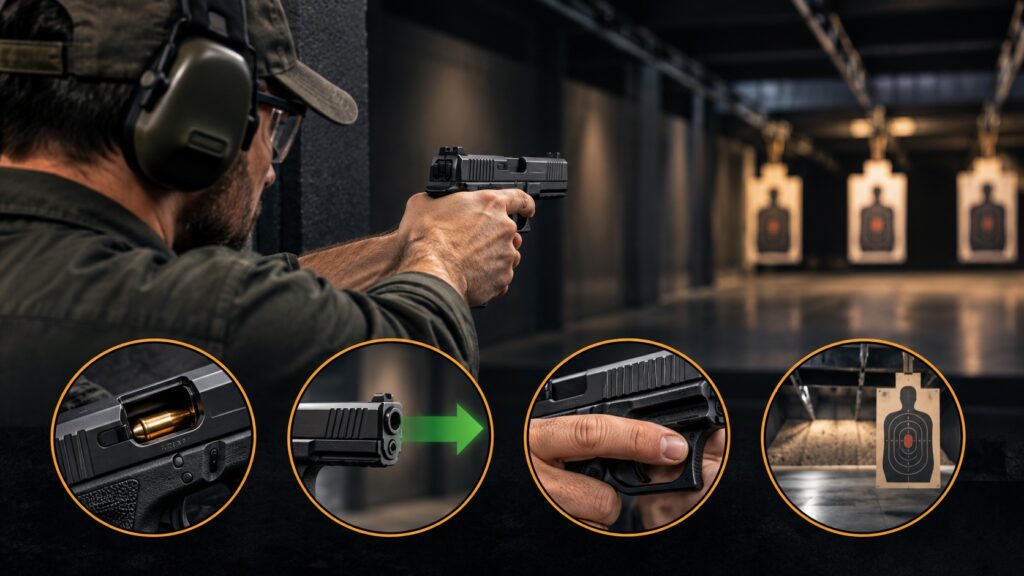
Gun safety is not the little lever on the side of a pistol.
It is a set of habits.
A firearm’s mechanical safety can fail, be disengaged accidentally, or simply not exist on a particular model. Safe gun handling therefore depends primarily on the person holding the firearm.
Whether you just bought your first handgun, have been shooting for decades, carry concealed, hunt, or keep a firearm for home defense, the same fundamental gun safety rules apply.
And nearly everything starts with four.
BLUF: The 4 Rules of Gun Safety
The four basic rules of gun safety are:
- Treat every firearm as if it is loaded.
- Always keep the muzzle pointed in a safe direction.
- Keep your finger off the trigger until you are ready to shoot.
- Know your target and what is beyond it.
Those rules closely track the four primary firearm-safety rules taught by the National Shooting Sports Foundation. NSSF
They are deliberately redundant.
If you make a mistake with one rule while still obeying the other three, the remaining rules may prevent that mistake from becoming a tragedy.
That is why experienced shooters don’t treat gun safety as a checklist they occasionally remember.
They turn it into muscle memory.
What Is Gun Safety?
Gun safety is the combination of handling, storage, training and maintenance practices intended to prevent negligent discharges, unintended injuries and unauthorized access to firearms.
It applies whether the gun is:
- at a shooting range
- being cleaned
- being transported
- being carried
- stored at home
- being shown to another person
- believed to be unloaded
That last one matters.
One of the most dangerous sentences around firearms is:
“Don’t worry. It’s unloaded.”
Check anyway.
A responsible gun owner does not become offended when somebody verifies the condition of a firearm. That’s exactly what they should be doing.
The 4 Rules of Gun Safety Explained
1. Treat Every Gun as If It Is Loaded
This rule eliminates assumptions.
Someone tells you the gun is unloaded?
Treat it as loaded.
You watched someone unload it?
Treat it as loaded.
You personally unloaded it five minutes ago?
Treat it as loaded.
This doesn’t mean pretending there is ammunition inside when you have confirmed otherwise. It means maintaining the same safe handling habits regardless of what you believe the firearm’s condition to be.
The habit is what protects you when your assumption is wrong.
Whenever you take possession of an unfamiliar firearm, don’t guess how it works. Keep it pointed safely, keep your finger away from the trigger and consult the manufacturer’s instructions or have someone qualified show you its controls.
2. Always Keep the Muzzle Pointed in a Safe Direction
Of all the gun safety rules, muzzle discipline may be the one with the greatest ability to prevent injury when something else goes wrong.
A safe direction is one in which an unintended discharge would be unlikely to injure a person.
And that direction depends on your surroundings.
Simply pointing a gun “down” is not automatically safe. There may be people below you, a hard surface capable of creating a ricochet, or material that a projectile can penetrate.
Likewise, pointing upward isn’t universally safe either.
The important habit is maintaining constant awareness of where the muzzle is pointing.
That includes when:
- picking up a firearm
- setting it down
- moving around other people
- loading or unloading
- clearing a malfunction
- drawing or holstering
- handling an unloaded firearm
The gun doesn’t get a safety exemption just because you believe the chamber is empty.
3. Keep Your Finger Off the Trigger Until You Are Ready to Shoot
Your trigger finger should normally remain straight and outside the trigger guard while handling a firearm.
Do not rest your finger on the trigger merely because the firearm has a mechanical safety.
Do not put your finger inside the trigger guard while moving.
Do not put it there while identifying a target.
Trigger discipline should become automatic.
Pick up a firearm and the finger goes straight.
Move and the finger stays straight.
Lower the firearm and the finger comes off the trigger.
Simple habits are easier to follow under stress than complicated ones.
4. Know Your Target and What Is Beyond It
Once a projectile leaves the firearm, you cannot bring it back.
Before firing, you need to know:
What are you shooting at?
What is around it?
What is behind it?
A paper target does not magically stop a bullet.
Neither does brush, drywall, a fence, or many ordinary objects people instinctively think of as barriers.
NSSF specifically emphasizes considering both the intended target and what lies beyond it because bullets can travel substantial distances and penetrate materials. NSSF
This rule matters at the range, while hunting and in any defensive context.
If you cannot identify the target, don’t shoot.
If you cannot account for what lies beyond it, don’t shoot.
Why the Four Gun Safety Rules Work Together
Think of the four rules as overlapping layers.
Suppose someone mistakenly believes a firearm is unloaded.
That’s a violation of Rule 1.
But if the muzzle remains pointed somewhere safe, Rule 2 still provides protection.
If the finger also remains outside the trigger guard, Rule 3 provides another layer.
And if nobody fires without identifying the target and background, Rule 4 adds yet another.
That redundancy is intentional.
Good firearm safety does not depend on never making a mistake. It creates multiple opportunities to keep a mistake from hurting somebody.
Where Is the Safety on a Gun?
This is one of the most common beginner questions, and the correct answer is:
It depends on the firearm.
There is no universal location for a gun’s safety.
Depending on the design, you may encounter:
- thumb safeties
- frame-mounted safeties
- slide-mounted safeties
- cross-bolt safeties
- tang safeties
- grip safeties
- trigger safeties
- internal firing-pin or drop safeties
Some modern firearms do not have an external manual safety at all.
That does not mean they lack safety mechanisms. It means the firearm was designed without a manually operated external safety switch.
If you are unfamiliar with a particular gun, don’t experiment with the controls while handling it casually.
Find the exact model’s owner’s manual or ask a qualified firearms instructor or gunsmith to demonstrate it safely.
NSSF likewise advises firearm owners to understand the specific mechanical and handling characteristics of the firearm they are using. NSSF
A Mechanical Safety Is a Backup
One mistake beginners sometimes make is believing:
The safety is on, so the gun is safe.
That’s the wrong mindset.
Mechanical safeties are useful.
They are not substitutes for muzzle discipline, trigger discipline and proper handling.
A better rule is:
Treat the firearm exactly the same whether the mechanical safety is engaged or not.
Gun Safety Doesn’t End With the Four Rules
The four rules form the foundation, but responsible firearm ownership includes several additional habits.
Use the Correct Ammunition
Only use ammunition appropriate for the exact firearm and caliber or gauge specified by its manufacturer.
Similar-looking cartridges are not necessarily interchangeable.
If you are unsure, stop and check the firearm markings, ammunition packaging and owner’s manual.
NSSF includes using the correct ammunition among its broader rules of safe firearm handling. NSSF
Wear Eye and Ear Protection
Shooting exposes you to significant noise as well as hot brass, debris and other hazards.
Use appropriate:
- hearing protection
- shooting glasses or other suitable eye protection
This applies even if you’re only observing from close proximity to active shooting.
Know How Your Particular Firearm Works
A Glock isn’t operated exactly like a 1911.
A revolver isn’t operated exactly like a semiautomatic pistol.
A pump shotgun isn’t operated exactly like an AR-pattern rifle.
The safety rules remain constant, but firearm controls and procedures vary dramatically.
Read the manufacturer’s manual before using an unfamiliar firearm.
Knowing how to shoot one gun does not automatically mean you know how to safely operate every gun.
What Should You Do If a Gun Doesn’t Fire?
If you pull the trigger and the firearm does not discharge when expected, continue treating it as loaded.
Keep the muzzle pointed in a safe direction and your finger away from the trigger.
Do not immediately look down the barrel or casually turn the gun toward yourself or another person to investigate.
Follow the firearm manufacturer’s recommended procedure or the instructions of a qualified range officer or instructor.
NSSF specifically cautions shooters to continue handling a firearm carefully after a failure to fire because a cartridge may still present a hazard. NSSF
Safe Gun Storage Is Part of Gun Safety
Gun safety continues after you leave the range.
Firearms that are not under the owner’s direct control should be protected against access by children, unauthorized adults, thieves and anyone who should not have access to them.
Depending on your needs, secure storage options can include:
- gun safes
- handgun lock boxes
- locking cabinets
- locking gun cases
- cable locks
- other firearm locking devices
Project ChildSafe recommends locked storage inaccessible to children and unauthorized users and describes firearm locking devices as an additional layer of protection. Project Childsafe
Hiding a Gun Is Not the Same as Securing It
Top shelves, closets, nightstands and other hiding places are not substitutes for actual security.
Children explore.
Burglars search.
Guests may encounter something you assumed nobody would find.
Project ChildSafe puts it plainly: a hidden gun is not necessarily a secured gun. Project Childsafe
The exact storage method you choose may depend on whether the firearm is used for hunting, recreational shooting, daily carry or home defense.
Whatever system you use, it should prevent unauthorized access.
Also check your state and local laws. Firearm storage requirements vary by jurisdiction and can change.
Gun Safety Around Children
Children should understand one rule before anything else:
If you find a firearm, don’t touch it. Tell an adult.
Gun owners have the greater responsibility, however.
You cannot reasonably expect curiosity alone to keep a child away from an unsecured firearm.
Secure storage provides the physical barrier.
Education provides another layer.
Project ChildSafe recommends teaching young people firearm-safety rules while also storing firearms so that children cannot access them without authorization. Project Childsafe
These conversations should also happen more than once.
As children get older, their understanding and exposure change.
Safety instruction should change with them.
Basic Gun Range Safety
Every shooting range has its own rules, but some principles are nearly universal.
Follow commands from the range safety officer.
Do not handle firearms while people are downrange.
Keep the muzzle pointed in the designated safe direction.
Keep your finger outside the trigger guard until you are preparing to fire.
Wear appropriate hearing and eye protection.
Never assume another shooter’s gun is unloaded.
And if you’re confused about something?
Ask.
Good instructors would much rather answer a beginner’s question than watch someone guess.
There is no prize for pretending you already know something involving firearms.
Firearm Safety Training: Who Should Take a Class?
Almost everyone can benefit from formal firearm safety training, particularly:
- first-time gun owners
- people buying their first handgun
- prospective concealed carriers
- hunters
- parents who keep firearms in the home
- people transitioning to an unfamiliar firearm platform
- experienced shooters who have not trained recently
A good beginner class should emphasize safety before speed or marksmanship.
Look for instruction covering topics such as:
- the four gun safety rules
- safe firearm handling
- loading and unloading procedures
- firearm controls
- safe storage
- range procedures
- malfunction safety
- basic maintenance
- applicable local laws
Live instruction also provides something YouTube cannot:
someone watching what you’re actually doing.
Small handling mistakes are much easier to correct before they become habits.
NSSF likewise recommends firearm owners consider safety courses and stresses close supervision for beginners handling unfamiliar firearms. NSSF
Gun Safety and Concealed Carry
Carrying a firearm adds another layer of responsibility.
A concealed handgun is handled around vehicles, clothing, family members and everyday activities rather than only under controlled range conditions.
That makes consistent habits even more important.
Your equipment, training and legal knowledge should all work together.
A firearm should be carried using equipment appropriate for that gun and the method of carry, and you should understand both your state’s carry laws and the firearm itself.
If you carry for self-defense, you may also want to understand what can happen legally after a defensive use of force. Tactical Equipment Armory’s CCW Insurance Guide covers the differences between firearm legal-defense programs, insurance and other forms of self-defense coverage. CCW Insurance: Gun & Self Defense Insurance Guide
Common Gun Safety Mistakes
Most dangerous firearm handling doesn’t start with some dramatic decision.
It starts with small shortcuts.
“It’s unloaded.”
Check anyway.
“The safety is on.”
Maintain proper muzzle and trigger discipline anyway.
“I’ve shot guns my whole life.”
Experience doesn’t make anyone immune to complacency.
“I’ll only set it here for a minute.”
Unauthorized access can happen during that minute.
“I know where the bullet will go.”
Make sure you also know where it can go if you miss or the projectile passes through the target.
“Nobody else is home.”
Safe habits should not disappear because nobody appears to be watching.
The point of training is to behave safely automatically.
Gun Safety FAQ
What are the four rules of gun safety?
The four basic rules are to treat every firearm as loaded, keep the muzzle pointed in a safe direction, keep your finger off the trigger until you’re ready to shoot, and know your target and what lies beyond it.
What is the most important gun safety rule?
There isn’t really one rule you should choose over the others.
The four basic rules are intentionally redundant.
Following all four gives you multiple layers of protection if something goes wrong.
Where is the safety on a gun?
The location and type of mechanical safety depend on the firearm.
Some guns have thumb, grip, cross-bolt or tang safeties. Others do not have an external manual safety.
Consult the owner’s manual for the exact model rather than assuming how its safety system works.
Are guns without manual safeties unsafe?
Not necessarily.
Many firearms use internal or automatic safety mechanisms rather than an external manual switch.
Regardless of design, no mechanical safety replaces proper firearm handling.
Should an unloaded gun still be treated like it is loaded?
Yes.
Treating every firearm as if it is loaded creates consistent handling habits and prevents assumptions from turning into accidents.
Should guns be locked up at home?
Firearms that are not under the owner’s direct control should be secured so unauthorized people cannot access them.
A firearm safe, lock box, cabinet or appropriate locking device can provide that protection.
Do I need firearm safety training?
If you are unfamiliar with firearms, formal instruction is strongly recommended.
Even experienced shooters can benefit from periodic training, especially when using a new type of firearm or preparing to carry concealed.
Gun Safety Is a Habit, Not a Gadget
You can buy safeties.
You can buy locks.
You can buy safes.
You can buy better holsters and better equipment.
But none of those replace disciplined firearm handling.
The basic rules remain remarkably simple:
Treat every gun as loaded.
Control the muzzle.
Keep your finger off the trigger until you’re ready to shoot.
Know your target and what lies beyond it.
Learn them.
Practice them.
And follow them whether you’re at a crowded shooting range or alone in your garage cleaning a firearm you know is unloaded.
That’s what responsible gun ownership looks like.
This article is intended for general firearm-safety education and is not legal advice. Firearm ownership, carry, transportation and storage laws differ by jurisdiction. Follow the manufacturer’s instructions for your firearm and applicable federal, state and local law.
Jared Fischer

Tactical Gear Armory is a group of tactical gear geeks! We specialize in everything from martial arts to AR-15's and other firearms.