PSA Dagger Review: Everything You Need to Know About PSA’s 9mm Pistol
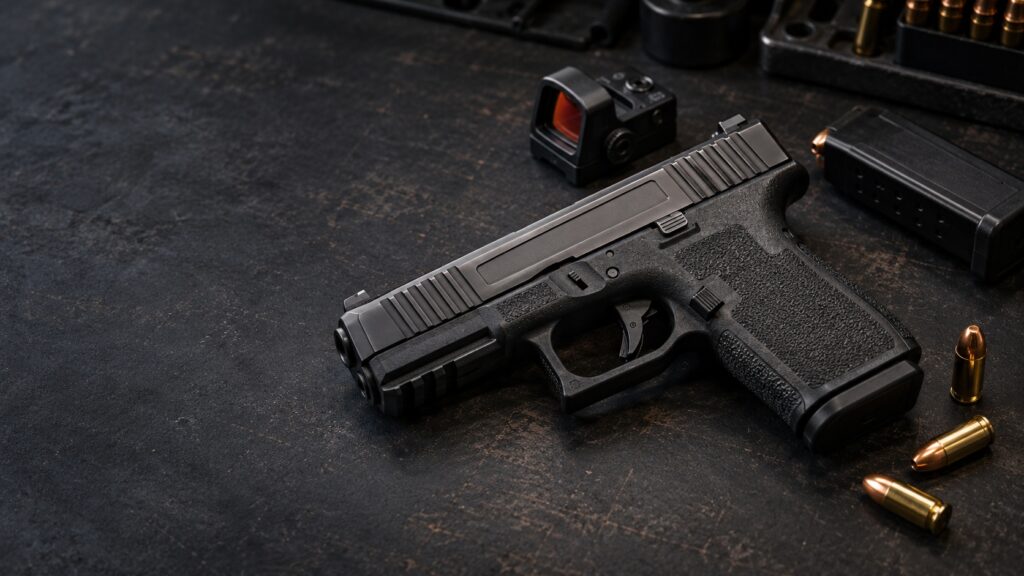
The PSA Dagger has become one of those pistols that is almost impossible to discuss without mentioning Glock.
That makes sense.
The original PSA Dagger Compact is a striker-fired, polymer-framed 9mm built around the basic architecture of the Gen 3 Glock 19. It uses the same general operating concept, accepts many Glock-pattern components, and competes directly with the Glock 19 in size and purpose.
But calling the Dagger nothing more than a cheap Glock clone misses most of the story.
Palmetto State Armory took a proven pistol format, changed the ergonomics, created its own frame and slide designs, offered a huge number of configurations, and then applied the aggressive pricing PSA has become known for.
Several years later, the Dagger is no longer just one inexpensive compact pistol. It has developed into an entire family that includes Compact, Full Size, longer-slide, Micro, and upgraded configurations.
So what exactly is a PSA Dagger?
Is it reliable?
What Glock parts fit?
Does it take Glock magazines?
Can you mount a red dot?
And, most importantly, is the PSA Dagger actually worth buying?
Let’s get into it.
What Is a PSA Dagger?
The PSA Dagger is a family of striker-fired 9mm semi-automatic pistols manufactured by Palmetto State Armory.
The original Dagger Compact was designed around the Gen 3 Glock 19 pattern. That gives it access to one of the largest handgun aftermarket ecosystems in existence while still allowing PSA to use its own frame, slide, barrel, controls, and other components.
The best way to describe the Dagger is as a Glock-pattern pistol, not an exact Glock copy.
That distinction matters.
A lot of Gen 3 Glock 19 parts and accessories work with the Dagger. Some do not.
The grip is different.
The trigger system is different.
The frame contours are different.
Certain pins and internal components are Dagger-specific.
An experienced Glock shooter will immediately understand how the pistol operates, but assuming that every Glock component will automatically fit a Dagger is a mistake.
PSA Dagger Compact Specifications
Specifications vary somewhat because PSA sells numerous Dagger configurations, but a typical PSA Dagger Compact falls into roughly the following range:
| Specification | PSA Dagger Compact |
|---|---|
| Caliber | 9mm Luger |
| Action | Striker-fired |
| Barrel Length | Approximately 3.9 inches |
| Overall Length | Approximately 7.15 inches |
| Height | Approximately 4.78 inches |
| Weight | Approximately 22 ounces |
| Standard Capacity | 15+1 |
| Frame | Polymer |
| Magazine Type | Glock-pattern double-stack |
| Basic Size Class | Glock 19 |
| Optics Ready | Available on many models |
| Threaded Barrel | Available on some models |
The important phrase here is many models.
PSA offers enough variations of the Dagger that two pistols carrying the same basic Dagger Compact name may have different:
- Slides
- Sights
- Barrels
- Finishes
- Optic cuts
- Thread patterns
- Magazine packages
Always check the specifications of the individual SKU rather than assuming all Daggers are configured the same way.
[CTA: See Current PSA Dagger Models and Configurations]
Is the PSA Dagger a Glock 19 Clone?
In practical terms, yes.
The PSA Dagger Compact is primarily based on the Gen 3 Glock 19 platform.
That is why Glock 19 comparisons dominate almost every discussion of the pistol.
The overall dimensions are similar.
The controls are familiar.
The takedown procedure is familiar.
The barrel and operating system follow the same basic pattern.
Many Gen 3 components are compatible.
Where things become more interesting is the frame.
PSA did not simply duplicate the Glock 19 grip.
The Dagger uses a more sculpted grip shape, a pronounced beavertail, an undercut trigger guard, aggressive texturing, and additional contouring around the frame.
For some shooters, that is actually one of the Dagger’s biggest advantages.
A common complaint about traditional Glock frames is that they can feel blocky. The Dagger provides a noticeably different interpretation of the same general pistol format.
That means someone who likes the mechanical simplicity of a Glock but does not particularly like Glock ergonomics may find the Dagger surprisingly comfortable.
PSA Dagger vs. Glock 19
This is the comparison almost every potential Dagger buyer eventually makes.
And the two pistols compete in very different ways.
Where the Glock 19 Has the Advantage
The Glock 19 has decades of history behind it.
Its strengths include:
- Massive aftermarket support
- Widespread holster compatibility
- Proven OEM magazines
- Extremely common replacement parts
- Long-term military, law-enforcement, competitive, and civilian use
- A very established reliability record
You are also buying into a platform that virtually every major holster, sight, magazine, and accessory manufacturer supports.
The Dagger cannot instantly reproduce decades of institutional history.
Where the PSA Dagger Has the Advantage
The Dagger attacks the market primarily on value and configuration.
Depending on the model, a Dagger may come from the factory with features such as:
- An optics-ready slide
- Threaded barrel
- Suppressor-height sights
- Aggressive slide serrations
- Different finishes
- Enhanced grip texture
- Numerous slide and frame combinations
Adding comparable features to another pistol can quickly increase the final price.
PSA lets buyers start much closer to the configuration they actually want.
And then there is the grip.
The Dagger’s more sculpted frame is one of the most consistently praised parts of the platform.
For someone who has always thought the Glock 19 felt like a very reliable two-by-four, that matters.
PSA Dagger Compact vs. Full Size
PSA’s naming can be confusing at first.
The Dagger Compact uses the shorter Glock 19-style grip and generally accepts a 15-round flush-fitting magazine.
The Dagger Full Size-S uses a longer grip that accommodates a 17-round flush-fitting magazine.
Here is the important part:
The Full Size-S does not necessarily mean a dramatically longer pistol.
Think of it more like combining a compact-length upper with a full-size grip.
That puts it conceptually closer to pistols such as the Glock 19X or Glock 45.
The longer grip provides additional magazine capacity and may be more comfortable for shooters with larger hands.
The tradeoff is concealability.
Grip length is often one of the most noticeable dimensions when carrying a handgun concealed.
What Is the PSA Dagger SX?
The Dagger SX extends the concept in the opposite direction.
Rather than primarily changing the grip, the SX uses a longer slide and barrel configuration.
The longer upper can offer:
- Longer sight radius when using iron sights
- Slightly more muzzle velocity
- Additional slide mass
- A different balance in the hand
For shooters who like the Dagger platform but want something closer to a full-size handgun, the SX is worth understanding.
What Is the PSA Micro Dagger?
The Micro Dagger is a different branch of the Dagger family.
Instead of competing with the Glock 19, the Micro Dagger competes in the slimline concealed-carry category.
Think Glock 43X and Glock 48 territory.
The Micro Dagger uses a narrower frame and smaller overall dimensions while still offering impressive magazine capacity for its size.
That makes it potentially more attractive for people primarily interested in concealed carry.
Do not assume Compact Dagger and Micro Dagger parts are interchangeable just because both pistols carry the Dagger name.
They are related product families, not identical platforms.
What Is the Sabre Dagger?
The Sabre Dagger takes the Dagger concept in a more premium direction.
Instead of buying an inexpensive pistol and upgrading it piece by piece, the Sabre approach adds many common upgrades from the factory.
Depending on the particular configuration, that may include:
- Enhanced slide machining
- Threaded barrel
- Upgraded magwell
- Extended magazines
- Optics capability
- Different frame treatments
- Upgraded controls
- Premium cosmetic finishes
It is essentially the answer to the question:
What happens when PSA takes the Dagger platform and builds something closer to a factory-custom pistol?
That also means the Sabre Dagger occupies a different price category from the basic Dagger Compact.
How Does the PSA Dagger Feel?
This may be one of the strongest arguments for the Dagger.
The grip does not feel exactly like a stock Gen 3 Glock 19.
The frame includes:
- A more pronounced beavertail
- Undercut trigger guard
- Aggressive grip texturing
- More sculpted front and backstrap areas
- Additional support-hand contact surfaces
The result is a pistol that many shooters find more natural in the hand than a traditional Glock.
The beavertail also helps encourage a high grip without putting the shooter’s hand dangerously close to the reciprocating slide.
There is one limitation worth mentioning.
The standard Dagger Compact does not offer the same kind of interchangeable backstrap system found on some modern pistols.
What you feel is essentially what you get.
For most shooters that will not matter.
For someone who regularly changes backstraps to adjust trigger reach or grip circumference, it is worth considering.
How Good Is the PSA Dagger Trigger?
The factory trigger is probably not going to be the reason anyone falls in love with the Dagger.
But it works.
The Dagger uses a hinged trigger safety rather than the narrow center-blade design found on a Glock.
Published trigger measurements generally place the standard pull in roughly the defensive-pistol range rather than competition territory.
Expect:
- Noticeable take-up
- A moderately heavy break
- Some creep
- A usable reset
- Nothing particularly exotic
Opinions on the trigger tend to be mixed.
Some shooters prefer it to the stock Glock trigger.
Others immediately start looking at aftermarket options.
The important distinction is that the Dagger trigger is functional rather than exceptional.
For a general-purpose pistol, that is not necessarily a problem.
Is the PSA Dagger Reliable?
This is the question that matters most.
And fortunately, the Dagger has now been around long enough that we are no longer judging reliability based solely on first impressions.
Published long-term testing across multiple PSA Dagger pistols has accumulated thousands of rounds through the platform.
Some testing has documented minor feeding issues during the first few magazines, particularly when starting with fully loaded magazines.
Those issues generally disappeared as the pistols broke in.
Longer-term testing has otherwise shown the Dagger capable of sustained reliable operation with both Glock OEM and Magpul magazines.
That is encouraging.
It does not mean every Dagger leaving the factory will be perfect.
No mass-produced firearm deserves that assumption.
Early production Daggers also generated reports involving issues such as:
- Trigger pins moving
- Trigger reset problems
- Individual feeding problems
- Occasional tolerance or fitment issues
Those reports appear much less central to the modern Dagger conversation than they were during the pistol’s early life.
The broader takeaway is that the Dagger has now accumulated enough real-world use that it should not be dismissed as an unproven novelty.
At the same time, PSA’s aggressive pricing does not magically eliminate the possibility of occasional quality-control variation.
PSA currently backs its manufactured firearms with a transferable lifetime warranty covering qualifying defects in materials and workmanship.
That warranty is worth remembering when evaluating a budget-priced firearm.
Does the PSA Dagger Need a Break-In Period?
A handgun should ideally function correctly from the beginning.
You should not have to explain away persistent malfunctions by saying the gun simply needs another 500 rounds.
That said, some Dagger testing has shown occasional early feeding behavior that disappeared quickly after the first few magazines.
The practical approach is straightforward.
Any new defensive handgun should be tested before being trusted.
That includes:
- The pistol
- The magazines you intend to use
- Your chosen ammunition
- Your optic, if equipped
- Any weapon light or other accessory
A Dagger should earn your trust the same way any other defensive pistol does.
Is the PSA Dagger Accurate?
Yes.
For the role it was designed to fill, the Dagger is capable of more accuracy than most shooters will realistically require from a compact defensive handgun.
Independent testing has repeatedly shown good practical accuracy with common range ammunition and quality defensive loads.
Longer-distance steel hits have also been demonstrated well beyond typical defensive handgun distances.
That does not turn the Dagger into a precision target pistol.
It simply means the gun itself is unlikely to be the limiting factor for most shooters.
As with many handguns, ammunition preference can matter.
A pistol may group noticeably better with one load than another.
If maximum accuracy matters to you, test several different loads rather than assuming the cheapest ammunition will tell you everything about the gun.
Does the PSA Dagger Take Glock Magazines?
Yes.
This is one of the Dagger’s biggest advantages.
The Dagger Compact uses widely available Glock-pattern double-stack magazines.
The Compact is built around the 15-round format.
Longer compatible magazines can also be used.
The Full Size-S grip accommodates a 17-round flush-fitting magazine.
Both Glock OEM and compatible aftermarket magazines are widely available.
That means Dagger owners do not have to rely on an obscure proprietary magazine ecosystem.
For anyone who already owns compatible Glock-pattern pistols, that can be a significant advantage.
Magazine capacity laws vary by jurisdiction, so always follow the laws that apply where you live.
Does the PSA Dagger Take Glock 19 Magazines?
Yes.
The PSA Dagger Compact is specifically designed around the same general magazine format used by the Glock 19.
That makes Glock 19 magazines one of the most natural choices for the platform.
Longer compatible Glock-pattern magazines can also function in the pistol, although they will obviously extend below the grip.
Does the PSA Dagger Fit Glock 19 Holsters?
Sometimes.
But do not assume it will.
This is one of the more common Dagger compatibility misconceptions.
The pistol may be similar in overall dimensions to a Glock 19, but its frame and trigger guard geometry are not identical.
That difference matters with rigid holsters.
A molded Kydex holster designed specifically around a Glock 19 may:
- Fit poorly
- Fail to fully seat
- Provide incorrect retention
- Interfere with the trigger guard
- Position the pistol improperly
For casual range transport that may simply be annoying.
For concealed carry, it is unacceptable.
Buy a holster specifically listed as compatible with the Dagger or verify compatibility directly with the holster manufacturer.
If the gun has a weapon-mounted light, optic, compensator, or other accessory, compatibility becomes even more important.
What Glock Parts Fit the PSA Dagger?
A lot of Gen 3 Glock-pattern components can work with the Dagger.
But “Glock compatible” should not be interpreted as “every Glock part fits.”
Depending on the component, compatibility may include things such as:
- Magazines
- Barrels
- Sights
- Slides
- Magazine releases
- Trigger components
- Recoil assemblies
- Various small internal parts
There are exceptions.
Some frame components and pins are specific to the Dagger.
Certain tolerances can also vary between aftermarket manufacturers.
The safest approach is simple:
Verify compatibility for the specific component you intend to install.
Do not assume that every part labeled “Gen 3 Glock” automatically drops into every Dagger.
That is especially important with fire-control and safety-related components.
Can You Put a Glock Slide on a PSA Dagger Frame?
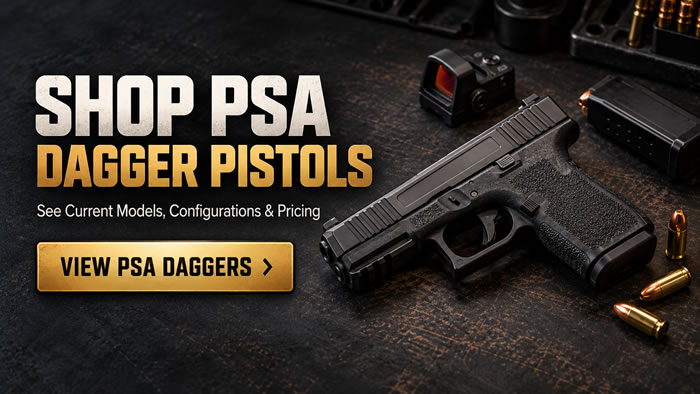
Many Gen 3 Glock 19-pattern slides and compatible aftermarket slides can work with the Dagger Compact frame.
That compatibility is one reason the Dagger became so popular with people who like building or customizing pistols.
But once again, tolerances matter.
An individual slide and frame combination may require verification before serious use.
Whenever major components are changed, function-test the pistol carefully before relying on it.
Can You Put a Red Dot on a PSA Dagger?
Absolutely.
In fact, optics-ready configurations are one of the strongest reasons to consider the Dagger.
PSA sells Dagger slides with different optic footprints.
Depending on the configuration, that can include common patterns such as:
- RMR-style cuts
- Doctor-style cuts
- Other configuration-specific optic systems
This is another area where checking the exact SKU matters.
Do not order an optic merely because a product listing says “PSA Dagger.”
Verify the footprint.
Some Dagger models also come with suppressor-height sights that can provide usable backup sights with certain red dots.
[CTA: Browse PSA Dagger Optics-Ready Models]
If you already know you want a red dot, buying the correct factory-cut Dagger can save you the trouble and expense of milling a slide later.
Does the PSA Dagger Come With a Threaded Barrel?
Some do.
PSA offers both threaded and non-threaded Dagger configurations.
A threaded barrel allows compatible muzzle devices or suppressors to be attached where legal.
The key word again is configuration.
The Dagger lineup changes frequently, so do not assume a particular model includes a threaded barrel unless the product listing specifically says so.
Can the PSA Dagger Run Suppressed?
Threaded Dagger models can be configured for suppressor use where legally permitted.
Published testing has demonstrated successful suppressed operation with appropriately configured Dagger pistols.
Suppressor reliability can depend on several variables, including:
- Suppressor weight
- Ammunition
- Recoil spring setup
- Barrel configuration
- Individual pistol tolerances
That is normal for many recoil-operated semi-automatic handguns.
Does the PSA Dagger Have a Safety?
Standard PSA Dagger pistols do not use a conventional external thumb safety.
Instead, they rely on passive safety systems built into the trigger and firing mechanism.
The Dagger includes a trigger safety along with internal striker safety features designed to prevent unintended firing when the pistol is handled correctly.
That makes a proper holster especially important.
Any holster used with a striker-fired pistol should completely protect the trigger guard.
Is the PSA Dagger Good for Concealed Carry?
The Dagger Compact falls into roughly the same overall category as the Glock 19, which has long been used for concealed carry.
So yes, it can certainly fill that role.
Whether it is the right size for you depends on:
- Body type
- Clothing
- Holster position
- Grip length
- Weapon light
- Optic choice
For shooters who want something smaller, the Micro Dagger may be more appealing.
Regardless of which model you choose, a defensive handgun should be thoroughly tested with the exact magazines and ammunition you intend to carry.
Reliability should be demonstrated, not assumed.
Is the PSA Dagger Good for Home Defense?
It can be.
The Dagger’s combination of:
- Familiar striker-fired controls
- Common magazines
- Accessory rail
- Optics-ready options
- Good practical accuracy
- Affordable replacement parts
makes it a reasonable general-purpose handgun platform.
A Full Size-S or longer-slide configuration may be particularly appealing to people who are less concerned about concealment.
Is the PSA Dagger Good for Beginners?
It can be, particularly because the basic operating system is relatively straightforward.
Advantages for newer handgun owners include:
- Simple controls
- Widely available magazines
- Large aftermarket
- Extensive accessory availability
- Affordable entry price
- Easy access to spare parts
- Common operating system
A new shooter should still receive proper firearms instruction rather than relying on the simplicity of the pistol.
The Dagger may be easy to operate, but safe handgun handling requires training.
Why Is the PSA Dagger So Cheap?
This question comes up constantly.
And it is one reason people initially approached the Dagger with skepticism.
Palmetto State Armory built much of its business around:
- High-volume manufacturing
- Vertical integration
- Direct-to-consumer sales
- Aggressive pricing
- Mature firearm designs
The Dagger benefits heavily from that model.
PSA did not need to invent an entirely new handgun operating system.
It started with the established Gen 3 Glock-pattern architecture and built its own version around it.
That allowed the company to compete aggressively on price without needing to create an entirely new ecosystem from scratch.
Cheap and inexpensive are not necessarily the same thing.
That distinction explains much of the Dagger’s success.
PSA Dagger Problems and Downsides
The Dagger is not perfect.
The Trigger Is Average
The standard trigger works, but few people are going to buy the pistol because of it.
There are better factory striker-fired triggers available.
Not Everything Glock Fits
Compatibility is extensive, but not universal.
This applies to parts, holsters, and accessories.
Holster Selection Requires Attention
Do not automatically buy a Glock 19 holster and assume everything is fine.
Verify Dagger compatibility.
Too Many Configurations Can Get Confusing
PSA offers so many combinations that the buying experience can occasionally feel like configuring a gaming PC.
A “Dagger Compact” may have completely different features from another “Dagger Compact.”
Read the product description carefully.
Quality Control Can Vary
The Dagger has accumulated plenty of successful long-term use, but occasional reports of individual QC problems still exist.
That is something to keep in mind when buying any aggressively priced firearm.
Glock Still Has the Longer Track Record
This is unavoidable.
The Dagger may be based on proven architecture, but it does not yet have decades of institutional use behind the Dagger name itself.
Who Should Buy a PSA Dagger?
The Dagger makes a lot of sense for someone who wants the benefits of the Glock-pattern ecosystem without necessarily wanting to buy a Glock.
It is especially appealing to:
- Shooters who dislike Glock grip ergonomics
- Buyers looking for an affordable optics-ready pistol
- People who already own Glock-pattern magazines
- Hobbyists who enjoy customizing handguns
- Shooters wanting an inexpensive range gun
- Buyers who want a threaded-barrel configuration without a large premium
- People looking for a general-purpose 9mm
It can also serve as an inexpensive entry point into the enormous Gen 3 Glock aftermarket.
Who Might Want Something Else?
A different pistol may make more sense if your top priority is:
- A decades-long institutional track record
- Universal duty-holster compatibility
- A premium factory trigger
- Interchangeable backstraps
- Maximum factory parts standardization
There is nothing wrong with acknowledging that.
The Dagger is compelling because of what it offers for the money, not because it somehow makes every other striker-fired pistol obsolete.
Is the PSA Dagger Worth It?
This is where the Dagger becomes difficult to ignore.
At the right price, you are getting:
- A proven operating concept
- Familiar controls
- Good ergonomics
- Widely available magazines
- Extensive aftermarket support
- Optics-ready configurations
- Threaded-barrel options
- Multiple frame sizes
- Multiple slide lengths
- A transferable lifetime warranty
The standard trigger is not spectacular.
Not every Glock accessory fits.
And there is still value in the longer track record of more established service pistols.
But the Dagger gives buyers a tremendous amount of handgun for relatively little money.
That is the platform’s real appeal.
[CTA: Check Current PSA Dagger Prices and Available Configurations]
Because PSA constantly rotates Dagger combinations, colors, barrels, slides, bundles, and optics packages, checking the current lineup makes more sense than relying on a single advertised MSRP.
PSA Dagger FAQ
Is the PSA Dagger a good gun?
The PSA Dagger has developed a solid reputation as an affordable Glock-pattern 9mm. Published long-term testing involving thousands of rounds has generally shown good reliability once the pistols are functioning properly.
Is the PSA Dagger reliable?
Overall evidence is encouraging. Some individual guns and early-production examples have experienced problems, but long-term testing across multiple pistols has demonstrated sustained reliable operation.
As with any defensive handgun, an individual pistol should be tested before being trusted.
What is the PSA Dagger a clone of?
The PSA Dagger Compact is primarily based on the Gen 3 Glock 19 platform.
Is a PSA Dagger a Glock?
No.
The Dagger is manufactured by Palmetto State Armory.
It uses Glock-pattern architecture and shares significant component compatibility with Gen 3 Glock pistols, but it is its own firearm.
Does the PSA Dagger take Glock magazines?
Yes.
The Dagger Compact uses Glock-pattern magazines and normally accepts Glock 19-size 15-round magazines along with compatible larger magazines.
Does the PSA Dagger take Glock 17 magazines?
Longer compatible Glock-pattern magazines can generally be used in the Dagger Compact, although they extend below the grip.
The Full Size-S is designed around the longer 17-round magazine format.
Is the PSA Dagger the same size as a Glock 19?
The Dagger Compact occupies roughly the same size category as the Glock 19, but the dimensions and frame geometry are not identical.
Will a PSA Dagger fit a Glock 19 holster?
Some holsters may work, but compatibility should never be assumed.
The Dagger has different trigger guard and frame geometry.
Use a holster specifically listed for the Dagger or verify compatibility with the manufacturer.
Is the PSA Dagger optics ready?
Many models are.
PSA offers Dagger slides with multiple optic-cut options.
Always confirm the specific optic footprint before purchasing a red dot.
What caliber is the PSA Dagger?
The standard PSA Dagger family discussed here is chambered in 9mm Luger.
How many rounds does the PSA Dagger hold?
A typical Dagger Compact uses a 15-round flush-fitting magazine.
The Full Size-S uses a 17-round flush-fitting magazine.
Micro Dagger capacities depend on the specific configuration.
Does the PSA Dagger have a manual safety?
Standard Dagger models use passive trigger and internal safeties rather than a conventional manual thumb safety.
Can you change the PSA Dagger trigger?
The Dagger has significant Gen 3 Glock-pattern aftermarket compatibility, including trigger-related components.
However, compatibility should be confirmed for any specific trigger system.
Safety-related modifications should also be thoroughly function-tested.
Can you build a PSA Dagger from separate parts?
PSA sells frames, slides, barrels, and other Dagger components separately in many configurations.
That has made the platform particularly popular among shooters who enjoy assembling customized pistols.
Applicable firearm laws still apply to serialized components.
Does the PSA Dagger have a lifetime warranty?
PSA currently backs its manufactured firearms with a transferable lifetime warranty covering qualifying defects in materials and workmanship, subject to the company’s warranty terms.
PSA Dagger Review: Final Thoughts
The PSA Dagger originally had a very simple sales pitch:
What if somebody built a Glock 19-style pistol and sold it for PSA money?
That description no longer captures the whole platform.
The Dagger has developed into an entire handgun family with Compact, Full Size, long-slide, Micro, optics-ready, threaded, compensated, and upgraded configurations.
More importantly, enough real-world use now exists that the Dagger can be evaluated on more than price.
The factory trigger is average.
Compatibility with Glock components is broad but not universal.
Holster selection requires more attention than some buyers realize.
And Glock still has a dramatically longer institutional track record.
Those are legitimate limitations.
But the basic Dagger formula remains extremely compelling.
You get familiar Gen 3 Glock-pattern architecture, widely available magazines, good ergonomics, respectable accuracy, enormous configuration flexibility, and one of the lowest barriers to entry in the modern striker-fired handgun market.
The PSA Dagger is interesting because it does not need to be a perfect copy of the Glock 19.
It takes the formula, changes a few things shooters have complained about for years, and sells the result at a price that is very difficult to ignore.
Tactical Equipment Armory

Tactical Gear Armory is a group of tactical gear geeks! We specialize in everything from martial arts to AR-15's and other firearms.